
Adionics’ CCO François-Michel Colomar talks about its work in direct lithium extraction (DLE), doing what no one else has: performing direct lithium salt extraction via a liquid-liquid process.
Edited by Donna Schmidt
A reduced footprint for lithium? Yes, according to global group Adionics, which has developed a technology based on the implementation of a selective extraction of salts; its liquid-liquid extraction based on a selective and thermally regenerated salt absorbent is called Flionex.
The company said its promise to the mining sector is simple: to enable not only a significant optimization of lithium production, but also align with more environmentally friendly practices.
In a segment where efficiency is key, Adionics recently told NAM that its approach can produce that as well as a reduced ecological footprint. According to its data, overall investments can be reduced by up to 30% versus traditional methods and operational costs can drop up to 20%. That’s before another big number: 90%, that being the percentage Adionics said it can help improve water consumption.
For some, the new technological turns with DLE are complex, never mind the work Adionics is doing to make it more effective. We wanted to know more about where the company’s work stemmed from, and where it’s headed.
NAM: Can you please share more about your DLE work and its current status?
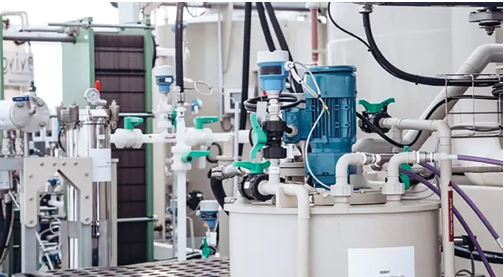
Colomar: To date, Adionics has studied a wide variety of brines. Around 260 brine compositions have been analyzed through our powerful modeling tool; 70 brines have been assessed at our CL1 facility as part of our feasibility-level studies; and 20 others have been tested on our CL15 demonstration pilot. Some trials have even reached up to 1,000 hours of continuous operation.
Altogether, these different test campaigns clearly demonstrate the performance and stability of our technology. We have also completed two process design packages for two industrial-sized plants.
In the meantime, Adionics is still developing new categories of its extraction media, the Flionex, to adapt it to new applications (battery recycling, fine-tuning for certain brine compositions, extractions of other salts, and more).
What is different, unique, and vital about DLE, in your opinion? What does it all mean for the future of lithium?
Today, lithium is extracted from hard rock (65%), brines (35%) and recycling (5%). What will be vital for the future of lithium is to improve the capability to extract more lithium from brines – more efficiently with less energy and less water consumption (higher recovery, higher purity and, hence, higher quality for end user, such as a battery or car maker). DLE will be a key contributor to increasing the use of lithium from brines.
Please put this into perspective for us. What statistics do you have on the advantages in terms of gallons and dollars and cents?
Today, in addition to lithium extraction techniques like evaporation ponds and hard rock mining, new methods such as DLE have emerged. Among these DLE technologies, our company offers a new approach designed to improve yield, purity, and lithium concentration.
Besides delivering high performance in lithium quality, our process also reduces water consumption compared, for example, to the amount of water required for hard rock processing. It also helps limit pH changes and reduces the need for acids during post treatment.
This is why we can say that Adionics’ DLE technology offers significant advantages for product quality (battery-grade lithium), project economics, and water& energy use.
Do you have stats on the advantages in terms of gallons and dollars and cents?
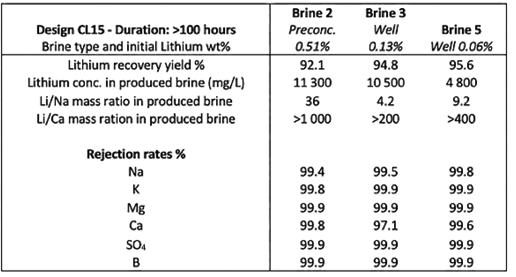
All stats are mentioned in our recent white paper. We can see that for the product performance, yield is greater than 90% and purity has a result greater than 99% rejection (on average). Water use is up to 10 times less, and concentrations are up to 10 times more.
These indicators have been measured in “real condition” use in our demo plant, and reflect the potential KPIs for large-scale project. OPEX/CAPEX information depends on each brine, localization and structure, but DLE technology brings strong benefits that significantly lower the overall project economics.
You mentioned your recent white paper above, but can you talk more about its findings?
The paper is a great opportunity to collect all the data from 260 brines’ composition modeling and 70 trials, and provides a testimonial of our performance and capacity to go to commercial scale. The idea is now to focus on other significative KPI such as energy consumption to strengthen the viability of our technology.
What are the implications of your work on lithium’s journey?
EV and ESS expansion require more lithium — and especially more battery-grade lithium. We expect demand to exceed supply by 2028. Producing high-quality lithium quickly will be essential, and new emerging technologies such as Adionics make it possible to meet this challenge.
We also need to integrate new ways of use, such as lithium recycling, into the value chain to recover the lithium already present in EV batteries and capitalize on its value by recycling it. Technologies like Adionics enable this and directly address this challenge.
Can you elaborate on the financial and environmental benefits of this technology for mining communities specifically?
As mentioned earlier, this new DLE technology significantly reduces water consumption, minimizes the environmental footprint, and lowers energy use. Each KPI naturally depends on brine characteristics, geographical location, and other operational parameters. Nevertheless, water and energy savings are clearly among the demonstrated performance indicators of our technology.
The high selectivity towards lithium of our extraction media has a direct impact on the purity of the lithium chloride we produce. This has an operational and financial impact on the process following the DLE (carbonation).
Indeed, the very high-purity lithium chloride we produce allows for reducing and simplifying the usual purification steps before carbonation, hence an overall reduction in CAPEX and OPEX.
Where do you see DLE going in the short term (10 years) and long term (20-25 years onward)?
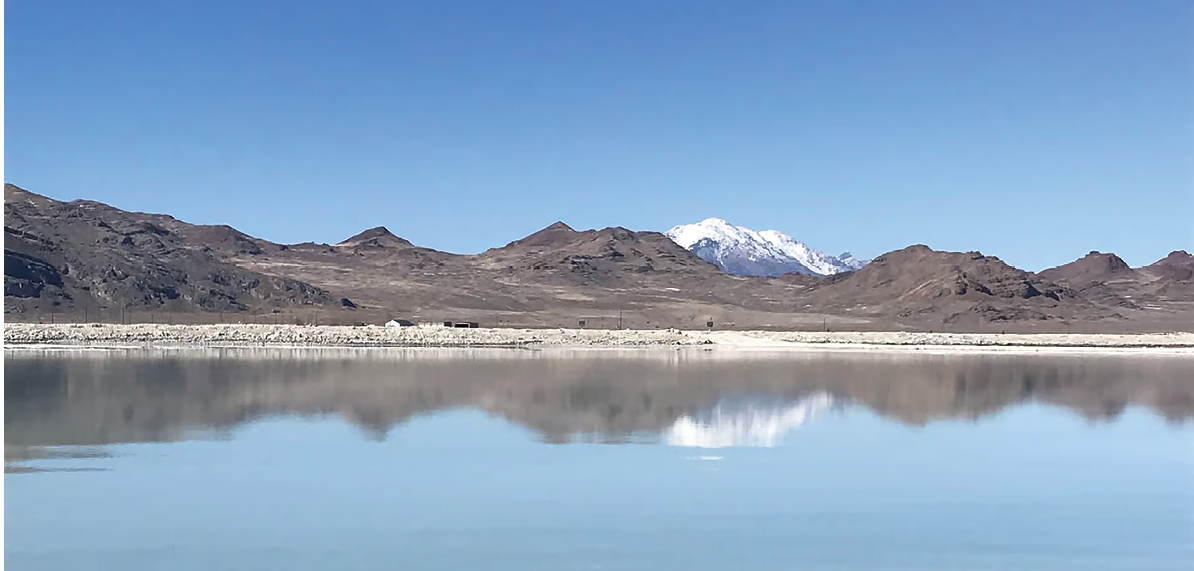
Our significant progress with our partners now enables us to lay the first foundations of the industrialization phase in several concrete projects. For example, our company, together with Intrepid and Aquatech, has just announced a joint development agreement to process a residual potash brine in Utah. We also expect demand to outpace supply by 2028, which will encourage mining companies to accelerate lithium production with short lead times. All these factors strongly indicate that DLE is poised to become the future standard in lithium production.
Editor’s note: the entire white paper and its methods and findings can be viewed at here (released November 2025). Photo: Adionics CCO François-Michel Colom.