
Recent developments are driving progress in surface mine electrification, sparking new opportunities to enhance productivity while also reducing emissions.
by Jonathan Rowland
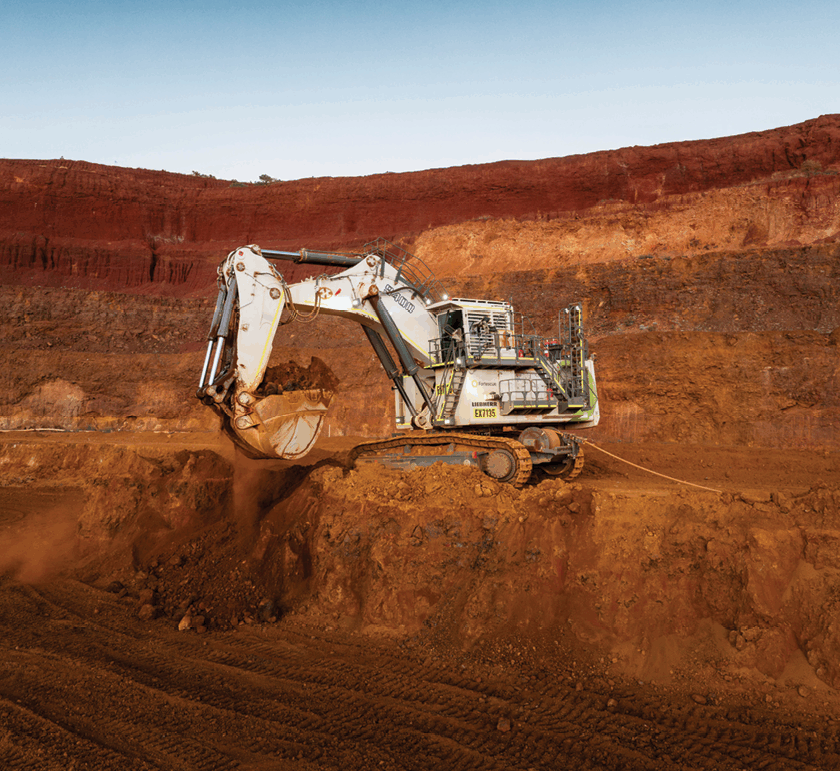
The mining industry has “always been built on scale, strength, and certainty,” said Daniel Robertson, marketing/sales manager at Innomotics; however, the climate conversation has “shifted expectations” with global mandates calling for a 50% reduction in CO2 emissions by 2030 and net-zero operations by 2050. This would be an “ambitious goal for any sector,” the Innomotics expert continued, but the challenge is particularly acute for an industry “powered by diesel-driven fleets.”
“Public expectations, policy mandates, and investor pressures are reshaping what it means to be a successful mining operator,” agreed David Rogers, North America regional director for Mining, Metals, and Minerals at Schneider Electric. Yet all this comes at a time when surging demand for critical minerals – particularly those essential to the energy transition – has sparked a new resources boom. “The mining industry finds itself at a crossroads,” Rogers added, explaining that mining operators must scale up production while scaling down environmental impact. This balance is “no longer aspirational; it is a strategic necessity.”
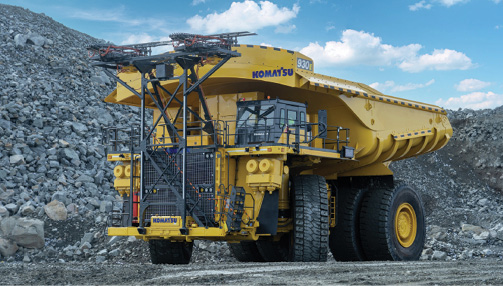
Balancing productivity and decarbonization goals will “rely heavily on electrification,” asserted Anthony Cook, vice president of sales and marketing for Electric Drive Trucks at Komatsu, as electrification is currently the “only approach that promises solutions that are competitive with diesel.” Schneider’s Rogers agreed, calling electrification the “first step in the transition to net-zero mining.” It is also much more than that, Rogers continued: it involves establishing a new operating model that integrates clean energy, digital intelligence, and autonomous capabilities into a sustainable and strategically agile system.
In an uncertain world, where geopolitical tensions, trade realignments, and energy volatility have complicated global trade supply chains, electrification is thus “a cornerstone of operational resilience and economic performance,” explained Rogers, who takes a broad view of the benefits of decarbonization. “Mines powered by decentralized energy, such as solar or wind, connected to a smart microgrid, are less vulnerable to fossil fuel price shocks or unstable utility infrastructures. This resilience is proving particularly valuable in politically sensitive regions where energy security directly impacts productivity.”
There is also a compliance angle, with electrification supporting compliance in an increasingly complex regulatory landscape. Whether it’s green procurement mandates in North America, the EU’s carbon border adjustment mechanism, or investor ESG frameworks, environmental considerations can no longer be considered optional hurdles, but “shape market access and financing,” Rogers noted. Electrification, alongside digital optimization, reduces Scope 1 and 2 emissions significantly, helping operations “stay ahead of environmental disclosures and avoid future carbon tariffs.”
Lastly, electrification offers an opportunity to enhance health and safety. As Komatsu’s Cook added, electric systems reduce exposure to diesel particulate matter and engine noise, improving working conditions for operators and support personnel.
Electrification’s promises are, then, ambitious, indeed. Yet ambition is not the issue, said Robertson, who described a broad willingness to change across the industry. The challenge lies in finding solutions that strike a balance between sustainability, safety, reliability, and profitability. “Because while the future must be greener, it must also be viable,” the Innomotics expert asserted. “Fortunately, parts of that future already exist.”
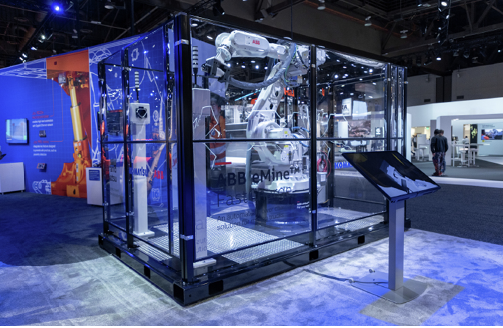
INNOMOTICS: A FOUNDATION DECADES IN THE MAKING
A relatively new name in the mining industry, having been formed from Siemens’ electric motors and large drive systems business in 2023, Innomotics nevertheless has an established pedigree. Its history in mining electrification dates to 1996, when (as Siemens) it introduced its first electric-drive system and launched trolley assist. This latter system was initially designed to reduce fuel burn, but with the “added benefit of cutting emissions,” noted Robertson. “In hindsight, the transition to net-zero mining may have started then.”
According to Robertson, these early innovations were part of a broader trend: one that sees increasing alignment between operational efficiency and decarbonization. “While sustainability drives headlines, productivity drives decisions. In mining, the equation remains: move as much material as possible at the lowest cost per ton. That is why electrification must deliver economic value, not just a smaller carbon footprint.” Supporting this point, Robertson pointed to several technologies that are already delivering results:
- Trolley assist provides grid power during high-load segments like uphill hauls, cutting fuel use and emissions (by up to 80%) while boosting speed and efficiency.
- Hybrid systems capture regenerative braking energy and reduce fuel burn, though space constraints limit battery capacity.
- Dynamic charging combines a trolley assist system and batteries to reduce engine reliance and onboard battery size, enabling engine-free operation without compromising performance.
“These are not future concepts; they’re working today and ready to scale,” added Robertson, who also argued against seeing trolley infrastructure as a short-term fix. “Lines installed today to support diesel-electric trucks can later power fully electric haul trucks through dynamic charging, making today’s decisions foundational to tomorrow’s success.”
Robertson also recognized that mining’s electrification push is not exclusive to new haul trucks. Solution providers must support diesel-electric and diesel-mechanical retrofits, enabling existing trucks to adopt electric drive systems, integrate with trolley assist, and reduce emissions, without waiting for complete fleet replacement (as Innomotics is doing). Innomotics has also partnered with OEMs to bring robust electric drives to a broader equipment ecosystem, including electric rope shovels. “Electrifying these workhorses represents another significant opportunity,” explained Robertson, “one that complements haulage electrification and amplifies environmental impact.”
Electrification is not a “standalone product; it is a system,” concluded the Innomotics expert, one that “no single company can deliver alone.”
Real progress will depend on collaboration across the entire value chain, including battery innovators, mechanical integrators, infrastructure providers, and mining professionals. “This is how we accelerate results: the more we align, the faster we move toward net-zero mining.”
Electrifying a major Chilean mining operation
In June 2025, Innomotics received an order for a major electrification project at a copper mining operation in northern Chile, which will see the company modernize critical infrastructure related to tailings handling and environmental management. The project scope includes engineering, supply, commissioning, and start-up of a fully integrated system comprising 71 medium-voltage drives, eight modular E-houses, and medium- and low-voltage distribution systems.
According to the company, E-houses help resolve the challenge of ensuring a comprehensive and reliable electricity supply in harsh mining conditions. A modular power distribution system, supported by digital solutions for future-oriented and dependable maintenance, E-houses drive efficiency from excavation to transportation and beneficiation, helping customers increase productivity and fulfil sustainability ambitions.
KOMATSU: ENABLING MULTIPLE ELECTRIFICATION PATHWAYS
Komatsu is “actively working to provide practical, scalable solutions that meet customers where they are today while preparing them for a zero-emissions future,” Sales and Marketing VP for Electric Drive Trucks, Anthony Cook, told North American Mining. The company’s approach is centered on providing flexible platforms that enable multiple electrification pathways, including battery-electric, hybrid, trolley-assist, and future fuels such as hydrogen.
“At the core of this strategy is our Power Agnostic truck platform, which enables operators to shift from diesel-electric to battery or hybrid propulsion systems over time, without the need to overhaul their fleet,” explained Cook. “This adaptability is critical in an environment where infrastructure, energy sources, and operating conditions vary significantly between sites. By decoupling the power module from the truck’s core platform, the Power Agnostic platform enables operators to tailor their power source to specific site goals and available infrastructure.”
The company also recognizes that electrification is not a “binary switch, but a progressive journey,” Cook continued, noting investment in technologies such as hybrid systems, biofuel compatibility, and trolley assist. According to the Komatsu VP, there has been a particular renewal of interest in the latter. “While its application is site-specific, typically best suited to uphill loaded haul roads, the potential benefits of trolley-assist systems are substantial.” Recent work from Komatsu’s infrastructure partner ABB aims to reduce implementation barriers by developing trolley-assist systems that are more compatible with existing operations, including modular overhead systems, simplified catenary designs, and fast-deployment technology.
Komatsu’s collaboration with ABB extends beyond trolley assist to delivering integrated solutions for stationary charging, dynamic energy transfer systems, and site-wide energy management. Komatsu’s site Energy Management System (EMS) and Fleet Management System (FMS), for example, are designed to work together to schedule refueling or recharging, allocate power budgets, and optimize haulage cycles, while ensuring the site stays within its energy constraints. These systems “help mining operations navigate power demand in a controlled and intelligent manner,” Cook said, “minimizing peak loads and aligning power usage with grid capacity or onsite generation.”
With charging technologies “expected to evolve fast,” continued Cook, “so too will our offering.” According to the VP, the company is currently in the advanced stages of validating next-generation energy transfer methods, including high-power 6.5-MW stationary chargers, fast robotic charging systems, and battery swapping concepts for underground equipment. Throughout this innovation, “interoperability remains a key design principle, ensuring that infrastructure investments made today will remain viable well into the future.”
Electrification also represents a significant cultural change, noted Cook, making effective change management and training critical enablers. For example, electric systems “require new competencies, especially as maintenance and operations teams adapt to high-voltage systems, new energy management protocols, and data-driven workflows.” Mining operations will have to work closely with equipment suppliers to ensure the transition is “well-supported through training, hands-on commissioning and service partnerships that span the full lifecycle of the equipment.”
Cook concluded by noting that “there is no one-size-fits-all solution in mining. Flexible and modular systems are necessary to enable mining operations to decarbonize today while planning for tomorrow.” For Komatsu, this means designing platforms that support incremental change and deliver immediate value, wherever a mine’s journey begins and however it progresses. “By combining proven equipment, innovative technology, strategic partnerships, and customer-centric collaboration, Komatsu is helping pave the way to a future where mining is not only productive but also sustainable, helping build a better future for the industry and the planet.”
Komatsu becomes the first to operate an electric drive truck with trolley assist autonomously
Announced in May 2025, Komatsu’s most recent contribution to mining’s electrification journey is the autonomous operation of a power-agnostic electric drive truck while connected to a dynamic trolley line. According to the company, integrating its trolley-assist system with its FrontRunner autonomous haulage solution represents an industry first. It is a “pivotal achievement in our roadmap toward decarbonizing mining operations,” said Martin Cavassa, Komatsu global business development manager for Autonomous Systems. The development provides “the pathway for managing battery-operated trucks autonomously,” which could enable further fuel savings and productivity gains.
LIEBHERR: ELECTRIC INNOVATION IN ACTION
Modularity is a core principle of Liebherr Mining’s design philosophy, explained the company’s Head of Zero Emissions, Dr. Isabelle Ays. The concept ensures agnosticism on energy type, machine application, and drivetrain technology in Liebherr Mining equipment, enabling machinery to be upgraded or retrofitted with current and future technologies throughout their entire life cycle. Regarding electrification specifically, the company has “years of experience and various solutions,” continued Ays, including diesel-electric, trolley-assist, and electric excavators, as well as the development of battery-electric trucks and battery-electric dozers.
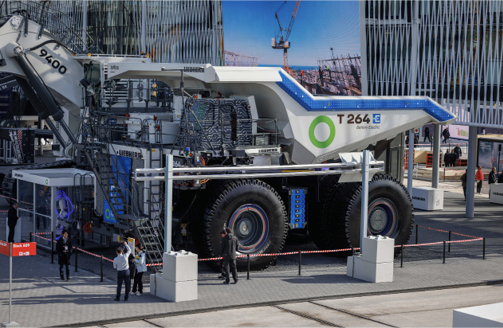
Liebherr’s latest concept for trolley systems is the Liebherr Power Rail, a class-agnostic concept based on the company’s proven trolley technology. “Instead of connecting to overhead power lines, Liebherr Power Rail will connect to power lines at the side of the truck, making the power transfer infrastructure easier to install and maintain,” explained Ays. “This lateral connection also allows trucks to navigate around curves.” With studies on Liebherr 360-tonne truck fleets showing that existing trolley-assisted diesel-electric trucks are up to 1.8 times faster than trucks without trolleys, resulting in production improvements of up to 21%, this latest concept is expected to encourage broader trolley-assist implementation.
Meanwhile, the company has partnered with mining company Fortescue to complete an autonomous battery-electric haulage solution for large-scale mining operations, as well as a battery-electric dozer. “The battery-electric T 264 240-tonne mining truck integrates a 3.2-MW battery developed by Fortescue Zero and will be available with a stationary fast charging solution that provides up to 6MW of power to charge the truck in under an hour,” said Ays. “We are set to deliver 360 of these trucks to Fortescue’s Western Australian operations by the end of 2030.”
Ays also highlighted the latest developments with the cable reel solution for Liebherr electric excavators, which offers up to 300 m of autonomous cable management to enhance manoeuvrability and ensure efficient cable management, increasing operational flexibility. Thanks to the modular design of Liebherr excavators, it is possible to convert an excavator from diesel to electric drive. The latest conversion was carried out in late 2023 on an R 9400 excavator in Western Australia, repowering the machine to an R 9400 E electric excavator.
Beyond these specific technologies, the following key considerations must be addressed by mining operators to succeed in the electrification journey, as Ays concluded.
Availability of renewable energy: Decarbonizing mining operations depends on a reliable supply of renewable energy to support the transition to zero-emission production. In regions where renewable electricity is unavailable or intermittent, alternative energy sources must be considered. The availability of these energy sources varies for each mine, depending on factors such as location, surrounding infrastructure, local market offerings, and political conditions. Based on its consulting simulation services, Liebherr Mining can provide customized solutions with its energy- and power-agnostic equipment to achieve the lowest possible cost per ton extracted for each mine.
Cost-effective energy transfer to the equipment: After procuring the energy, the key point is delivering it to the equipment in a cost-effective manner. One solution is dynamic power transfer systems, such as traditional overhead trolley systems or the Liebherr Power Rail. Although the initial investment is higher, the total cost of ownership over the truck’s lifetime can be lower than that of traditional diesel equipment. This lower cost results not only from energy prices but also from the increased productivity achieved through dynamic power transfer, which enables faster speeds on ramps.
Modular, energy and powertrain-agnostic mining equipment: A mine’s lifetime is long, and forecasting its future, especially in today’s environment where no single solution fits all, makes it challenging for mines to decide, select, and implement the right solution. Since no one can predict the future with certainty or fully mitigate this uncertainty, mines must ensure a high degree of flexibility. Liebherr Mining addresses this need by offering modular, energy- and powertrain-agnostic equipment that can be upgraded or retrofitted to meet the mine’s evolving requirements.
Liebherr Mining delivers complete trolley system to Chilean copper mine
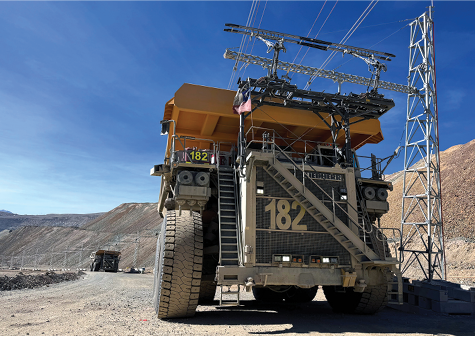
In July 2025, Liebherr Mining commissioned a complete one-kilometer trolley solution at the Collahuasi mine in Chile. The trolley line was engineered to handle extreme altitude, high winds, and seismic activity, and included retrofitting four T 284 trucks with pantograph connections, as well as all relevant infrastructure. The company also provided training for the truck operators. The mine has now assumed operational control of the trolley line, with Liebherr continuing to support mine staff with additional training and technical expertise.
Retrofitting the pantograph technology to Collahuasi’s four T 284s was managed by Liebherr’s sales and service company in Chile, Liebherr Chile, with support from Liebherr’s truck production facility in Newport News, Va. To reduce downtime, the retrofit process was completed in stages. First, modifications were made to the trucks’ superstructures to make them trolley-ready. When construction of the trolley infrastructure was beginning to wrap up, technicians from Liebherr Chile fitted the pantographs. “This project is a clear example of what is possible through collaborative partnership,” commented Oliver Weiss, executive vice president, R&D, Engineering, and Production, Liebherr-Mining Equipment SAS.
SCHNEIDER ELECTRIC: ELECTRICITY 4.0 – AN EXPANSIVE AGENDA
Moving the conversation away from heavy mobile equipment, David Rogers, Schneider Electric North America regional director for Mining, Minerals & Metals, highlighted two critical yet energy-intensive infrastructure systems where electrification is already yielding results: dewatering and ventilation.
“By transitioning from diesel or compressed air to electric ventilation systems with integrated variable-speed drives, operations have achieved energy savings of more than 20%,” Rogers noted. “These systems now offer tighter control, reduced downtime, and easier integration with smart grid platforms.” Meanwhile, a major copper producer in Chile’s Atacama desert achieved a 35% reduction in energy consumption when it electrified its water supply system and tied it into a solar-powered microgrid. “With the growing scarcity and cost of water, strategies like these have become central to sustainability targets and cost control.”
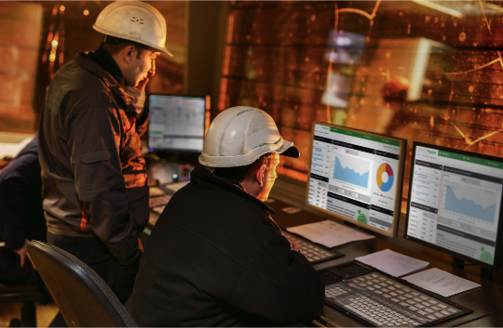
Rogers also highlighted the critical (but often underappreciated) role of smart monitoring and control systems in the electrification process. “Integrated platforms backed by real-time monitoring, AI-enabled analytics, and remote access are helping operators identify inefficiencies early, optimize load management, and even forecast equipment stress before failure occurs,” observed the Schneider executive. “These technologies routinely deliver significant gains in energy efficiency across site infrastructure, while cutting unplanned maintenance by up to 20%.”
This approach – integrating electrification with renewable power, advanced energy management, and real-time data intelligence into one cohesive strategy – Rogers called Electricity 4.0, epitomising the ambitions of electrification. “It enables mines not only to decarbonize, but also optimize capital allocation, reduce operating costs, and extend asset life: key priorities in an industry with slim margins where energy costs can swing the profitability of a project and operations.”
Is this all futuristic thinking? Rogers thinks not, noting that forward-looking companies are already investing in these systems. “In a future shaped by a growing resource need, climate policy, and digitally connected markets, electrification will be the baseline for success,” he concluded.
A CALL TO ACTION
Net-zero by 2050 “is not optional”, asserted Innomotics’ Daniel Robertson in conclusion; it’s already a “moving train”. The question is “whether we help drive it, are content to be passengers, or get left behind.” For Schneider’s David Rogers, this highlights the need for a “first, decisive step: electrifying the systems that keep mining running, and doing so with intelligence, flexibility, and purpose.”
Success will not be the purview of one initiative or partner, however. It will come from “a series of strategic moves, applied consistently across the industry,” concluded Robertson. “Many of the tools already exist. The know-how is available. What’s needed now is commitment – from suppliers, OEMs, regulators, and miners alike. Because if we want to meet the moment, we cannot wait for perfect; we have to start today.”