
Mining operations invest heavily in understanding their orebodies and planning extraction, yet value still leaks at multiple points between the resource model and the processing plant. Where does it go?
by Jonathan Rowland
Geological models, mine plans, expected feed characteristics: mining is a multi-billion-dollar business built on a series of presumptions. But reality is not one to be held to presumptions. At each stage of the mining process, real-world performance introduces variability from expectations. The results can be costly. Ore is lost to waste dumps, while gangue dilutes the ore stream. Material is misclassified, mis-blended, or fed to the plant with characteristics that differ significantly from what was planned.
WHERE IS MY ORE?
It begins with the geology itself. As Eclipse Data Innovations’ Rudy Moctezuma explained, geological variability and the inherent limitations of exploration data mean that resource models, however sophisticated, are always approximations. Incorrect interpolation furthers the risk. The result is grade overestimation, which creates a domino effect throughout the value chain.
“Despite many years and many hundreds of millions of dollars spent on exploration, ore body knowledge is relatively coarse,” agreed John Slaven of MineSense Technologies. Consider that the smallest mining units (SMUs) typically range from 15,000 to 20,000 tons, and that each SMU is assumed to have a homogeneous grade. This often results in payable metal being lost to SMUs classified as waste, while waste dilutes units classified as above the cutoff grade.
And that’s before mining has even begun. From the blast onward, “material progressively loses its identity,” said Rayleen Hargreaves of Datamine. Blasting can displace material 3 to 25 meters from the model. Trucks are redirected, dig boundaries are interpreted differently across shifts, and stockpiles gradually become mixed inventories rather than controlled ones. “By the time material reaches the plant, the issue is often not just loss,” she concluded. “It is that you no longer have confidence in what you are processing.”
It can be a muddle, then, but not one that necessarily points to poor planning or ill-discipline, as Hexagon’s James Dampney said.
Instead, it is the “cumulative impact of losing material traceability and understanding at critical transitions, combined with limited ability to adapt decisions as conditions change.” Dampney argued that most mines today actually have reasonable visibility through the core load-haul-dump cycle, thanks to fleet management systems that track equipment movement, payloads, volumes, and destinations. The biggest gaps “sit on either side of this core workflow.”
Upstream, once a blast has occurred, maintaining clarity on what material was actually blasted and how it moved is challenging.
In heterogeneous orebodies – particularly metal mines where the distinction between ore and waste is critical – blast-induced displacement can significantly shift material from its planned location.
If this movement is not accounted for, the boundaries defined in the model no longer reflect reality. Meanwhile, blast fragmentation is one of the most direct upstream levers on plant performance. When fragmentation is poorly controlled or not measured in relation to its downstream impact, the comminution circuit absorbs the cost through reduced throughput, higher energy consumption, and increased wear.
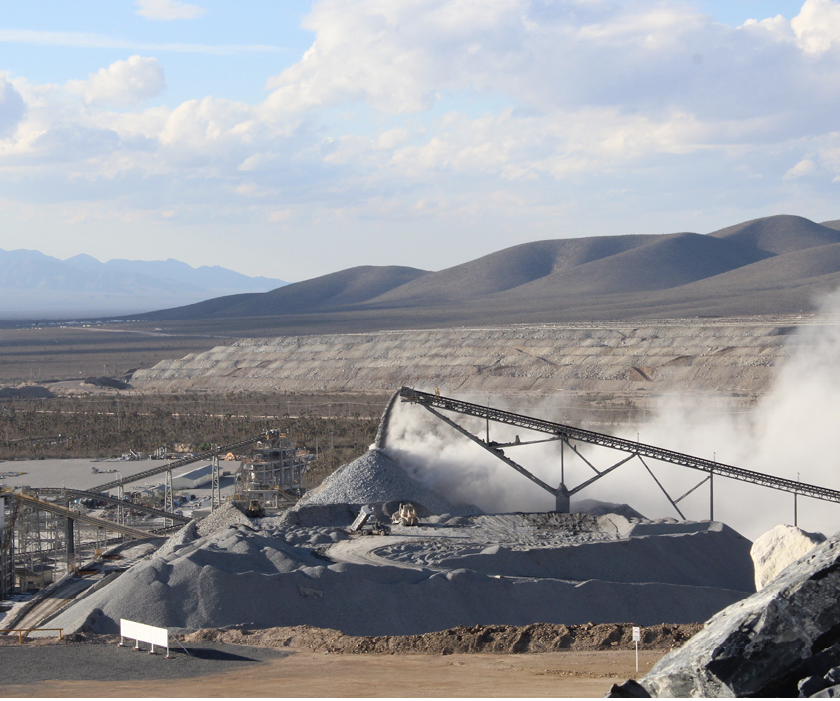
Downstream, the critical blind spot is stockpiles, with all the experts identifying these as the points at which material understanding drops off most sharply. The challenges are manifold. Material location after dumping is seldom recorded diligently, while ore of different grades may be blended with limited planning. Material characteristics can change while in the stockpile, altering its processing behavior. Despite various attempts – sampling, block modeling, custom algorithms – no one has fully solved the challenge of understanding how material actually behaves once it has been dumped and blended.
The nature of the visibility gap also varies by commodity. In heterogeneous orebodies, early loss of ore-waste traceability has the greatest downstream impact. In more homogeneous bulk commodities, the challenge shifts toward understanding and controlling material characteristics such as hardness, moisture content, and blending behavior as the feed approaches the plant.
A final point, emphasized by MineSense’s Slaven: tracking movement alone is not the same as understanding value. Most mines have reasonable visibility of the volume of material moved at major handoff points, he noted, but without accurate characterization, even well-tracked material provides only a partial picture. MineSense’s experience indicates that more than 10% of material is misclassified at the time of loading the haul truck due to an incomplete understanding of quality.
PROBLEMS IN THE PROCESS PLANT
The impact of this compounding degradation in visibility is felt most keenly in the process plant, where costs are the highest and least flexible. Here, performance depends on receiving material with known volume, grade, and blend characteristics. When that understanding has been lost, the plant is “forced to operate on assumptions, rather than reality, reducing throughput, recovery, and grade,” Hexagon’s Dampney said.
Sending below-cutoff-grade material to the mill also consumes unnecessary water, energy, and reagents while adding to the tailings stream, noted Slaven, while transferring payable material to tailings means that it is “commercially lost forever.”
Hargreaves described a common pattern: something changes in the mill, leading to an investigation within the plant. But the root cause lies in how the material was mined or blended earlier. “Without that connection, it is hard to fix,” she said. “The financial impact is rarely one big event; it is incremental: small losses, repeated over time.” Illustrating the impact, Eclipse’s Elsa Castillo described how poorly characterized material might enter the grinding circuit, leading to suboptimal conditions, such as under- or overgrinding. Consequences include reduced equipment utilization, increased energy consumption, lower concentrate grades, and diminished mineral recovery.
Hexagon provided several customer examples.
At one operation, a 2.2% reduction in dilution delivered a 1.1% increase in high-grade output – equivalent to $5.7 million per year – alongside a 2.2% uplift in truck productivity and 6% higher utilization.
In a separate mine-to-mill program, improved fragmentation control increased mill throughput by 0.5% and reduced specific energy by 1.5%, delivering about $4 million per year in energy savings. And at another site, improved flow management lifted crusher throughput by 21% and increased truck dumps by 25%.
FROM RETROSPECTIVE TO REAL-TIME
All contributors described a shift in how material tracking and reconciliation technology is operating, moving from periodic, retrospective reporting to continuous, connected, and increasingly real-time systems.
Hargreaves described the core change simply: reconciliation used to be something done at the end of the month in spreadsheets, trying to explain variance after the fact. What is changing now is the ability to connect data across the chain and maintain continuity as material moves through it. “The real difference,” she said, “is being able to see where things start to diverge, not just that they did. Once you can pinpoint where the divergence starts, the conversation shifts from explaining variance to actually managing it.”
Characterizing material at the point of extraction is key to this shift, said MineSense’s Slaven. For example, XRF sensors mounted on loading equipment can capture grade and material characteristics within milliseconds, and integrate that information with fleet management systems to support informed routing decisions. “This is one of the most consequential and lowest-cost opportunities to achieve real-time bulk ore sorting,” Slaven said. “Adding dynamic cutoff control, the system can also flex material flow to the mill or stockpile based on available capacity, ensuring the highest-value destination for each truckload at that point in time.”
The same sensing approach can also be applied post-crusher on the conveyor belt, creating a two-point characterization system that tracks material quality both at the point of extraction and as it enters the processing circuit. This provides a closed loop, whereby upstream decisions about material routing can be validated against downstream measurements, strengthening confidence in the data and enabling continuous calibration.
When materials enter the conveying system, plants also need visibility that supports volume-based control, as many downstream constraints are “volumetric in nature,” said Hexagon’s Dampney: “Monitoring volume enables earlier detection of bottlenecks, more stable downstream feeding, and faster correction of abnormal conditions such as blockages, spillages, or surges.” The result, he noted, is improved plant predictability, higher sustained throughput, and less time spent reacting to variability.
Dampney also highlighted high-resolution, radar-based systems that can monitor bulk material movement and inventory in real time, including fill levels, stockpiles, crusher zones, belts, and transfer points. Critically, radar operates reliably in dusty, wet, low-visibility environments where traditional optical systems or manual inspection struggle.
There is also a shift toward reusing existing data sources – particularly those originally deployed for safety – to drive operational optimization.
According to the Hexagon expert concluded. Technologies introduced to reduce collision risk or manage traffic separation now inform haulage optimization and material flow efficiency, reducing congestion and smoothing flow to crushers.
CONNECTING THE CHAIN
What does a well-integrated material tracking system actually look like, then? For Hargreaves, it comes down to a simple test: “You should be able to follow a ton from the model to the mill and explain what happened to it.” That includes what was expected, what was mined, where it went, how it was stored or blended, and what the plant actually received. Most sites can answer parts of that question, she noted. Very few can answer it end-to-end without stitching things together manually.
Slaven described this integrated vision as connecting inherent value, intent, execution, and outcome. The geological model defines the expected value distribution. The mine plan converts this into a sequence of extraction. Grade control refines understanding at the block- or blast-level. Fleet management routes material. Plant systems adjust parameters to maximize throughput and recovery. When these systems are connected – and when real-time characterization data from the face flows through to processing – planned value can be compared with actual outcomes, and feedback can improve future decisions.
“Without integration, each function optimizes in isolation, and value is lost between handoffs,” he concluded. “With it, variability is exploited rather than absorbed.”
According to Eclipse’s team, managing this web of interconnected relationships must go beyond adopting open formats and shared APIs, which require work to set up, may miss details, and can still be fragile in implementation. In contrast, knowledge graph-based software encodes the relationships between data points rather than just the connections. “An assay does not just sit in a table; it belongs to a drillhole, which contributed to a block model, which informed a mine plan,” explained the company’s Sean Hunter. “That layered understanding pushes the industry toward unified solutions where everything is tracked within a single system.”
The resulting visibility – operators, planners, and metallurgists seeing the same picture – enables more connected decision-making. “Transparency across the material flow enables greater trust between teams, clearer accountability, and stronger alignment between planning and execution,” said Slaven. “It also lays the foundation for more resilient operations.”
BARRIERS TO ADOPTION
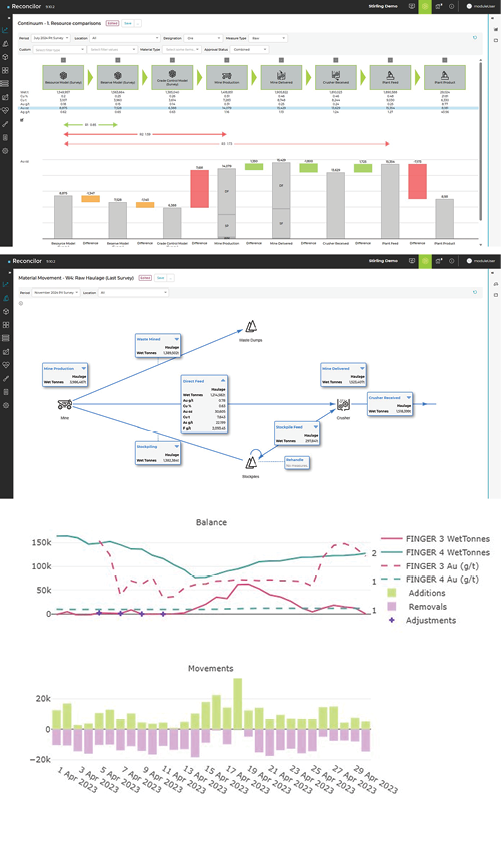
The barriers to better material tracking are “rarely technical,” said Hexagon’s Dampney. Fragmented ownership between geology, mining, and processing teams, each with different priorities and performance metrics, was cited by all. Datamine’s Hargreaves put it directly: “If responsibility stops at department boundaries,” she said, “the problem will not go away.”
Reconciliation itself is also still often treated as a reporting task – something that happens at the end of the month – rather than an operational capability that supports daily decisions. However, the latest solutions do something different: they continuously learn from the mine, building context from every data point, decision, and outcome. Adopting this requires a “genuine shift in how organizations think about intelligence in their systems,” Eclipse’s Castillo said, “and that cultural change is often harder than any technical implementation.”
The advice from the experts was consistent. Start with a clearly defined value problem, not the technology. Identify where value is being lost and how better material insight could change decisions. Focus on connecting what already exists rather than introducing more systems. Secure executive sponsorship and cross-functional ownership. And look for measurable outcomes early to build confidence and reduce perceived risk.
LOOKING AHEAD
The mining industry has long accepted a degree of uncertainty in how material moves through operations and how its value changes along the way. But it no longer needs to. Several pressures make this transition urgent, including tighter margins, deeper and more complex deposits, and growing scrutiny around resource efficiency. “The cost of continuing with reactive, data collection-only approaches is no longer just operational inefficiency; it is a strategic risk,” said Eclipse’s Moctezuma, who also highlighted the endemic loss of tribal knowledge as seasoned engineers or experienced operators retire.
These people “knew why certain decisions were made, how a particular orebody behaves, and what the quirks of a specific piece of equipment mean at 2 AM on a night shift,” he said. “That knowledge has never lived in a database. A living knowledge graph, built on ontology, is one of the few approaches that can capture and preserve that institutional intelligence continuously – not as a one-time documentation exercise, but as an organic part of how the operation learns and grows.”
A final challenge is organizational. As Datamine’s Hargreaves noted, most operations have more data than they realize. The challenge is making sense of it in a way that people trust. “Reconciliation, when it works well, is not about proving a number,” she said. “It is about making the system visible enough that you can understand what is actually happening.” The mines that start building that foundation today will be the ones able to make confident, informed decisions tomorrow.
MEET THE EXPERTS
Elsa Castillo is a client experience engineer at Eclipse Data Innovations.
James Dampney is senior vice president of Product at Hexagon’s Mining Division.
Rayleen Hargreaves is a principal consultant and the Reconcilor product owner at Datamine.
Sean Hunter is the director of Product Development at Eclipse Data Innovations.
Rudy Moctezuma is chief business relations officer at Eclipse Data Innovations.
John Slaven is the CEO and a member of the board at MineSense Technologies.