
Tailings water management is a critical challenge for mining operations, though the precise nature of that challenge varies dramatically from one operation to the next.
by Jonathan Rowland
Tailings dams account for the most water losses at most mining operations. Recovering that water can significantly reduce both environmental impacts and freshwater costs. Yet the feasibility of tailings water recovery depends on factors largely beyond the tailings engineer’s control – from the scale of operations and climate to ore characteristics and regulatory constraints.
Take the size of the mine: larger hard-rock and industrial mineral operations use more water than smaller precious metals mines. Yet smaller operations can deploy a wider variety of recovery technologies precisely because they implement them at smaller scales, Amanda Adams of Stantec explained.
Climate is equally influential. In the Southwestern United States, water scarcity drives copper operations toward technologies such as paste thickening and filtration. However, high evaporation in these regions can increase tailings water salinity and reduce flocculant performance when water returns to the circuit, noted Nick Lancaster of Weir. Arid-region mines may also store water in tailings impoundments during wet seasons for use during drought, requiring careful attention to beach sizing and freeboard for dam safety during extreme weather events.
Northern operations face different constraints. In parts of Canada, geochemical concerns have led to wet covers over tailings to prevent acid generation, said Adams. Maintaining this cover while ensuring dam safety can be problematic. Freeze-thaw cycles add complexity by altering tailings and dam geotechnical properties, reducing shear strength during thaw. Ice immobilizes water during winter and then rapidly releases it in spring, thereby stressing reclaimed systems.
Whether mines are operating in dry, wet, or cold climates, climatic and seasonal extremes demand careful water balance modeling, including sensitivity analyses and climate change scenarios, said Adams’ Stantec colleague, Nicholas Brink. They also affect technology selection: filtered tailing stacks that are efficient and safe in arid regions can be challenging to implement in areas with abundant rainfall.
Beyond physical constraints, mines must navigate regulatory requirements and ESG pressures that can lock in tailings strategies during permitting, thereby limiting flexibility for process changes in subsequent reviews, Lancaster noted. High capital costs for advanced technologies, combined with remote locations, create additional barriers to implementing enhanced water-recovery systems. And then, of course, there are the tailings themselves.
HOW TAILINGS CHARACTERISTICS IMPACT WATER RECOVERY
The physical and chemical properties of tailings fundamentally determine which water recovery strategies will prove effective – and economical – at any given operation. According to Rachel Jansen of Paterson & Cooke, three key characteristics are involved: mineralogy (specifically, clay content), particle size, and process water chemistry.
Surface-active clays such as smectite and illite significantly affect dewatering by forming dispersed, colloidally stable slurries, Jansen explained. At the same time, a high fraction of fine materials (<20µm), particularly in the -2µm size fraction, will also reduce a material’s dewaterability, complicating conventional filtration. For example, fine fractions and clays directly influence thickener sizing, flocculant consumption, overflow clarity, and internal dilution requirements in thickening operations. For filtered tailings applications, Jansen noted, “there is a practical upper limit to the fines and clay mineral content that can be filtered economically.” Beyond this, producing specification-grade filter cake becomes increasingly tricky.
While clays provide the most pressing challenge, they are not the only mineralogical factor in the equation.
Minerals with plate-like structures, such as mica, can also adversely affect filtration performance due to unfavorable particle shape and orientation, added Jansen. Yet, as Adams noted, the particle size distribution and mineralogical composition of any given tailings stream are governed by characteristics of the original ore body and processing decisions, over which tailings engineers have “very little influence.”
Beginning with the orebody
Time for a quick introduction to the orebody’s impact on dewatering. Ore bodies containing hard, relatively unaltered minerals produce coarser tailings that readily release water, Adams explained. For example, taconite (iron) ores tend to be harder and less altered; copper and nickel ores are classified as intermediate; while gold requires more extreme geological conditions for mineralization, typically leading to finer, lower-permeability tailings.
Miners have essentially no control over these characteristics beyond deciding which ore bodies to exploit. Once a specific ore body is selected, the only control over tailings properties comes from mill operations.
Yet, mill operating decisions prioritize economic mineral recovery rather than tailings dewatering optimization. For example, due to financial considerations, copper concentrators typically use a coarser grind, more suitable for water recovery, than gold circuits, where the higher price per pound makes recovery of even small gold particles worthwhile.
Beyond hard rock mining, potash and oil sands present their own “unique challenges,” according to Lancaster. Conventional potash tailings are characterized by high NaCl salt concentrations. The tailings must thus remain in saturated brine throughout thickening and disposal to prevent dissolution of the NaCl salts and ensure effective thickening, filtration, or centrifugation. In contrast, potash solution (brine) mining produces fewer solid tailings but large volumes of liquid brine that must be managed. Oil sands tailings present another extreme: very fine material containing residual hydrocarbons forms slow-settling slurries with high water content, resulting in large, persistent tailings ponds.
This variability makes materials testing essential for long-term success, emphasized equipment supplier McLanahan. “Analyzing the tailings stream to identify which minerals are present enables the best water recovery strategy to be determined. Computer simulations and pilot-plant testing can then demonstrate effectiveness and confirm operational parameters before full-scale implementation.”
WATER CHEMISTRY CONSIDERATIONS
In addition to all other considerations, the process water chemistry is a “critical component of the solid–liquid system and plays a significant role in dewatering behavior,” said Jansen. For example, increasing salinity by adding lime or other salts can facilitate the dewatering of complex tailings by modifying the surface charge characteristics of fine particles and clay minerals, thereby reducing colloidal stability. Lowering tailings pH can also improve dewatering performance.
Recovery marks only the first challenge, however. Recovered water with high salt concentrations, residual reagents, suspended solids, or dissolved metals can harm downstream equipment and processes, Lancaster warned. Treatment steps such as filtration, pH adjustment, or reverse osmosis may be necessary to restore water quality but incur costs. Repetitive recycling can also trigger “microbial growth and contaminant and ionic build-up,” requiring periodic intervention.
TECHNOLOGIES AND APPROACHES
Water recovery typically occurs at two points: the dewatering plant and the tailings storage facility. Optimizing the balance between them is essential for controlling costs and minimizing operational risk, Jansen explained.
Proven technologies: thickeners and filters
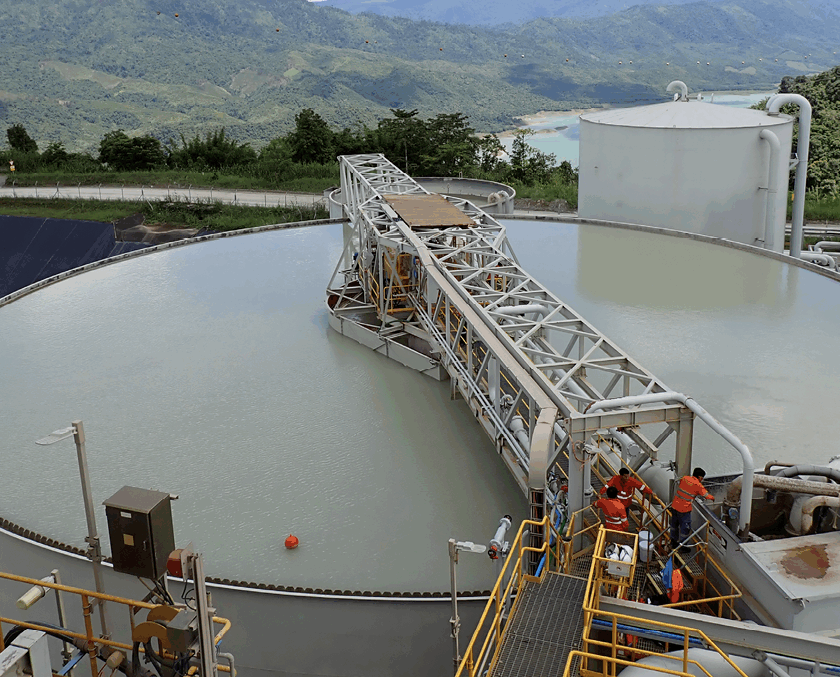
Thickener systems with strong operational control – using appropriate instrumentation and automated control loops – adjust flocculant dosing in response to feed variations, Jansen noted. This improves the consistency of the underflow concentration while reducing flocculant consumption. Meanwhile, the use of active forced-dilution systems in the feedwell allows the thickener feed dilution ratio to be controlled across varying thickener feed conditions. Modern thickeners typically include such systems, though retrofitting older installations with upgraded feed systems and control strategies can significantly enhance performance.
Following thickening, tailings are usually pumped via a pipeline to the storage facility, as Jansen continued. Properly sizing the slurry transport system for the full range of operating conditions proves essential – incorrectly sized transport systems become bottlenecks. Jansen cited cases in which pumps were incorrectly specified and were unable to accommodate the higher yield stresses associated with thickened tailings. This necessitated slurry dilution to facilitate transport, thereby partially reversing the dewatering achieved in the thickener.
Alternative strategies, such as filtered tailings, require holistic evaluation, Jansen advised. While dewatering costs increase exponentially at higher water recoveries and filtration is inherently more expensive than thickening, “broader considerations such as water savings, tailings facility construction costs, and the desired final landform may justify these dewatering costs.” For high-tonnage operations, a staged approach – filtering only a portion of the tailings initially before transitioning to complete filtration – can achieve meaningful water recovery while deferring capital expenditures.
Emerging technologies
Looking ahead, several new technologies show promise for expanding water recovery capabilities over the next decade, according to Brink.
- Electrokinetic dewatering: Electrical currents have recently been used to classify tailings and release water. Some approaches selectively attract or repel charged particles to
segregate tailings during deposition, while others use electro-osmosis to draw water toward a cathode. Laboratory and small pilot studies show promise, but these
methods remain energy-intensive and can generate
hazardous byproducts, such as hydrogen gas. Where water
is scarce and tailings volumes are modest, electrokinetic methods may prove viable, though they require careful optimization of tailings chemistry. - Centrifugal water separators: Modern continuous-process machines spin tailings in a precisely angled horizontal drum, decanting water from the inner drum face while pushing solids out through the outer face. These systems have become more efficient, flexible, and reliable in recent years, with the potential to rival filtration technologies for water recovery performance.
- Passive drains can extract water from existing impoundments, though with limitations. Prefabricated vertical drains (PVDs), such as wick drains, exhibit declining efficiency over time and rely on naturally occurring pore
pressures to drive water upward. Novel approaches that
apply vacuum pressure to PVDs have been implemented at some active facilities to enhance drainage, and these
technologies may gain wider adoption despite current limitations.
Beyond mechanical dewatering, digital integration and advanced monitoring will provide valuable insights for effective tailings management, said Lancaster. Intelligent platforms will enable real-time optimization of water recovery circuits and predictive maintenance.
A return to traditional methods
Simpler historical methods are also “returning to prominence,” continued Brink. “Classifying tailings using hydrocyclones separates coarser underflow from finer overflow, with the sandy underflow readily releasing water when stacked on lined pads with underdrainage. While fine overflow retains more water, this approach still improves overall recovery compared to depositing unclassified tailings, particularly for naturally coarser materials.”
Lastly, the most basic water recovery method remains strategic depositional planning.
“Careful control of deposition locations and rates creates stratified impoundments with coarser layers that facilitate lateral drainage,” explained Brink. “Combined with passive underdrainage systems and properly filtered granular drains, this approach can achieve rapid water recovery, especially in smaller impoundments.”
RECENT DEVELOPMENTS IN WATER RECOVERY SYSTEMS
McLanahan’s QUICKCHANGE filter press exchange system
The patents-pending QUICKCHANGE system is a rapid filter cloth changeout system that streamlines filter cloth replacement and filter plate inspection, increasing uptime. Traditional filter cloth maintenance is typically labor-intensive and may require specialized lifting equipment. In contrast, the QUICKCHANGE system allows each cloth to be replaced in 1-2 minutes without requiring maintenance personnel to enter or climb onto the press.
Weir’s Terraflowing dewatering technology
The Terraflowing dewatering technology employs a customized flowsheet that combines cycloning, paste thickening, filtration, and centrifugation to handle variable tailings characteristics. This flexibility allows operators to increase water recovery by up to 55% relative to conventional thickening alone, produce engineered paste products for use in filtered-stack tailings or backfill, and adapt to site-specific conditions, such as particle size and mineralogy.
STARTING POINTS FOR SUCCESSFUL WATER RECOVERY
Mining operators seeking to improve water recovery should begin with comprehensive characterization and planning rather than technology selection. Analyze everything, McLanahan advises: processes, feed material, tailings streams, water sources, and water demands. A well-considered water balance is an essential part of this planning, supporting informed decisions about the benefits and drawbacks of various technologies for each site, Brink added.
Proper geotechnical characterization of tailings consolidation will allow operators to understand when entrained water will be released and plan for its recovery and reuse, continued Brink. Water use is least efficient during and immediately after the startup of a tailings facility. As facilities mature, they liberate entrained water, effectively serving as water storage, with discharge rates governed by tailings properties – highly beneficial in water-scarce environments, where released water can support increased throughput without additional freshwater supply.
Ultimately, planning for change across a range of factors is the order of the day, whether that is the release of entrained water over time, changes in pit geology, such as increased clay content later in operations, the impact of climate change, or the expansion of mine throughput.
Designs must account for multiple variables changing simultaneously, concluded Adams. Since mines typically grow over time and water recovery technologies don’t always scale well, sensitive operations may benefit from combining recovery methods, providing flexibility while identifying which technologies work best for future expansion.
MEET OUR EXPERTS
Amanda Adams is a principal and business center operations leader in Stantec’s Mining, Minerals & Metals practice.
Nicholas Brink is an associate geotechnical engineer in Stantec’s Mining, Minerals & Metals practice.
Rachel Jansen is a senior process engineer and Tailings manager in Paterson & Cooke’s North American practice.
Nick Lancaster is product manager for Weir’s mine dewatering and tailings management equipment.
McLanahan supplies tailings and water management equipment and solutions to the mining industry.
MINEXXT, a subsidiary of the Paterson & Cooke group of companies, provides solutions for optimizing process equipment.