
Greg Baiden argues the answer will determine who controls the 21st century.
For over a decade, we’ve been told we’re entering the Fifth Industrial Revolution. The progression seemed logical. Steam engines gave way to electricity, microchips to automation, and now to AI. History marches to a predictable, familiar drumbeat.
Or does it? Let’s consider for a moment that this comfortable framing is fundamentally wrong. Could we instead be witnessing not another industrial cycle, but something unprecedented: the first technological revolution? This moves us far from past experiences into an era where computation, materials, and physical infrastructure merge into a single system that rewrites civilization. It might sound far-fetched, but there is a growing technological, geopolitical, economic, and material case for this perspective.
If this proves correct, our current assumptions about industrial strategy, supply chains, and national security are based on outdated models.
The most strategic sector of our era is not software or semiconductors, but mining, specifically, next-generation robotic mining supported by intelligent optical networks, forming the foundation of future technological infrastructure.
MOVING OUTSIDE THE INDUSTRIAL FRAMEWORK
Industrial revolutions have always centered on machines: spinning frames, steam engines, assembly lines, and microprocessors. Each wave automated labor and reorganized production. But today’s emerging systems aren’t simply more advanced machines. From autonomous robotics and AI to spatial computing, ubiquitous sensing, and quantum-ready networks, they represent something categorically different.
Data no longer describes the world; it constitutes it. Code isn’t running atop physical infrastructure, it is infrastructure. AI isn’t a tool, it’s a decision-making layer embedded throughout the economy. Computing is becoming a sovereign capability equal to energy.
This isn’t a new industrial cycle. This is a new substrate for civilization. And substrates have rules that are determined not by technologists or legislators, but by material constraints.
THE PHYSICAL BOTTLENECK
Despite narratives about the weightlessness of the digital age, reality tells a different story. AI infrastructure, electrification, and autonomous systems demand unprecedented volumes of specific minerals:
- Copper for power and computer cooling.
- Nickel for batteries and superalloys.
- Cobalt for cathodes.
- Rare earths for magnets and robotics.
- High-purity silica for photonics.
- Graphite for thermal systems.
From this perspective, far from being an industry of the past, mining becomes the foundation for every model of the future. But, geopolitical reality adds two critical constraints: we need minerals at scale and quickly, while society increasingly rejects traditional mining methods. Reconciling these contradictions demands a new mining paradigm that is safer, more precise, more socially legitimate, and far more productive.
It requires robotic mining connected by intelligent optical networks.
THE NERVOUS SYSTEM OF MATERIAL INTELLIGENCE
The Penguin Optical Network System (PONS) exemplifies this structural shift in how physical environments are digitized and controlled. Traditional communication networks fail underground, underwater, or in dust-heavy environments. Not so PONS, enabling multi-kilometer optical communication where radio dies, centimeter-scale 3D positioning for robotic systems, and real-time digital twins of orebodies and geological structures.
By integrating hyperspectral, magnetic, and seismic data into a geospatial blockchain, the system thus enables swarm-level autonomy across multiple robotic platforms. In effect, PONS transforms a mine from an isolated physical site into a programmable, high-fidelity intelligent environment. In an era where physical and digital systems merge, this capability becomes essential, not optional.
THE AUTONOMOUS INDUSTRIAL SYSTEM
If PONS is the nervous system, robotic mining is the self-governing organism.
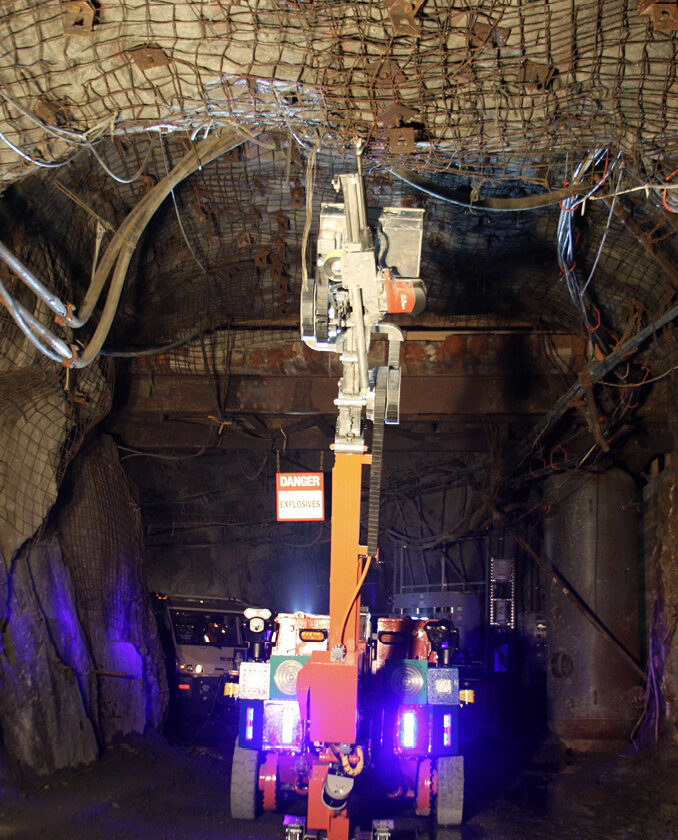
Next-generation robotic mining introduces zero-entry production, keeping personnel out of the orebody through AI-driven drilling, mapping, blasting, and haulage; autonomous face analysis using multispectral and geophysical sensors; and real-time geologic reconciliation.
This transforms mining into a continuous computational process rather than a sequence of mechanical steps. It allows nations to reopen legacy districts, develop new deposits, and secure supply chains with dramatically less cost, risk, or social opposition. The approach delivers more precision, more data, more resilience, less human exposure, less environmental disturbance, and higher throughput.
In this framing, mining becomes not an extractive industry but the enabling industry for every other advanced system.
STRATEGIC CONTROL IN THE TECHNOLOGICAL ERA
If this were merely the Fifth Industrial Revolution, we’d focus on manufacturing productivity and incremental digitalization. But if this is the First Technological Revolution, the logic fundamentally changes. Access to critical minerals becomes synonymous with national security, and so robotic mining becomes a sovereign capability, held as closely as a country’s military or energy infrastructure. Optical networks become the industrial nervous system of this Brave New World, while autonomous fleets become the only path to meet global demand responsibly.
This might sound hyperbolic, but consider this.
The countries that secure intelligent mining capacity will control AI supply chains, energy transitions, semiconductor production, defense manufacturing, and computing infrastructure.
The countries that don’t will find themselves technologically dependent, regardless of their AI talent pool.
THE REVOLUTION BEGINS AT THE OREBODY
History will judge whether we correctly judge what is happening now. However, if we continue framing this as the Fifth Industrial Revolution, we risk assuming continuity: manageable change, predictable cycles, familiar solutions. If we recognize we’re entering the First Technological Revolution – a world where autonomy, computation, energy, materials, and intelligence converge – mining becomes not a relic of the industrial age, but the starting point of this new era.
The future won’t be written in code alone. It will be written in atoms, precisely extracted, autonomously processed, continuously networked, and globally optimized. The nations that master robotic mining won’t just participate in the 21st century. They’ll shape it.
About the author: Greg Baiden is chairman and CEO of Penguin Automated Systems.