
Hexagon, already active in the mine safety space, has been working with great focus on its mission to take collision avoidance underground. The company recently spoke with NAM about getting to the crucial juncture and what’s ahead.
by Donna Schmidt
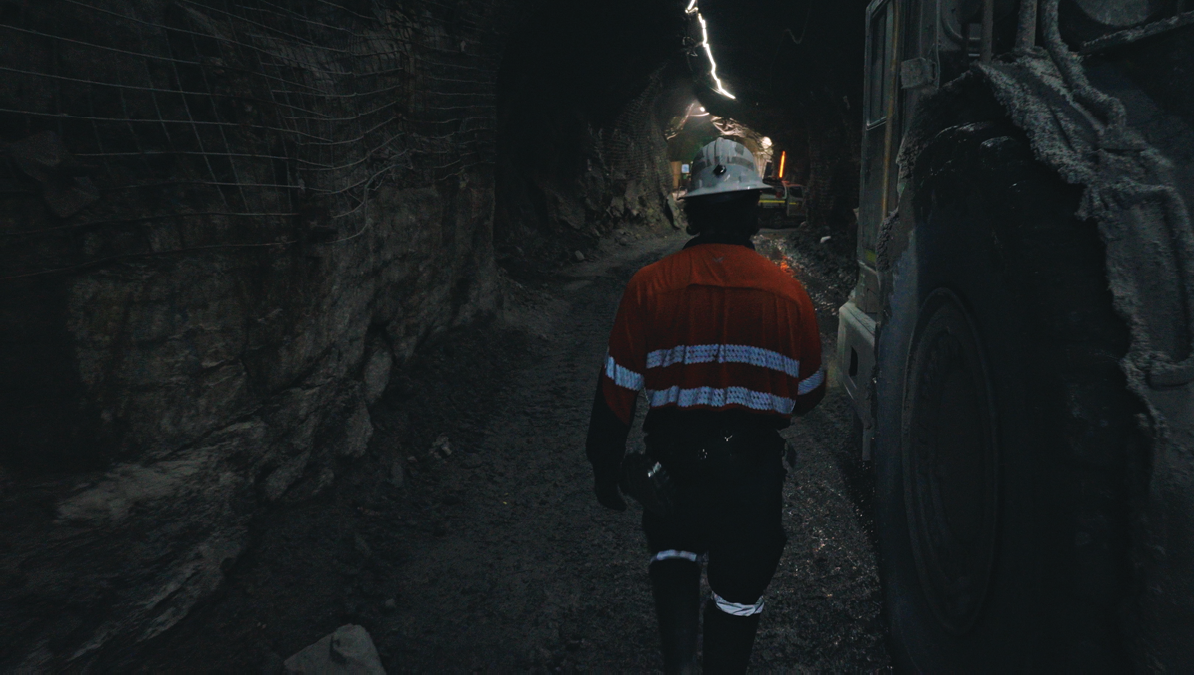
Hexagon has been working for some time to transition its collision avoidance system technology for use underground.
“At Hexagon, everything we do in mining is grounded in one non-negotiable principle: people must go home safely at the end of every shift,” according to mining president David Goddard. Therein lies the core of Hexagon’s work, boosting safety even further for all miners through its systems.
It is that, too, which served as a jumping-off point for its continued work in the area of miner safety related to the company’s collision avoidance system and taking that underground. That work went into high gear last July when it set what it called a benchmark for mine safety with a world-first system integration: the launch of its Operator Alertness System (OAS) 7.5, which integrated operator alertness monitoring with the company’s Collision Avoidance System (CAS 10) to deliver insights into vehicle interactions and operator behavior.
The new release featured numerous enhancements expanding upon the existing capabilities of OAS. Last summer, Hexagon said integration with CAS 10 would enable the automatic capture and display of predicted collision event videos, giving safety personnel a real-time window into critical events and operator performance.
The system was tested in a field deployment at Whitehaven Coal’s operations in Australia; the trial spanned an entire fleet and ran for more than a cumulative 10,000 operating hours.
In the field, the integration worked with exceptional processing efficiency, averaging just 5.8 seconds for event videos to be remotely available for review, and all with minimal network impact due to advancements in edge-based video data handling.
Whitehaven Coal called the trial “a significant step forward” for operational safety and data-driven learning.
“Whitehaven has concluded a successful trial that integrated Hexagon’s OAS and CAS technologies, providing a step forward in vehicle interaction and collision awareness learnings. This successful trial was achieved through genuine collaboration, innovation, and a shared drive to make mining operations safer.”
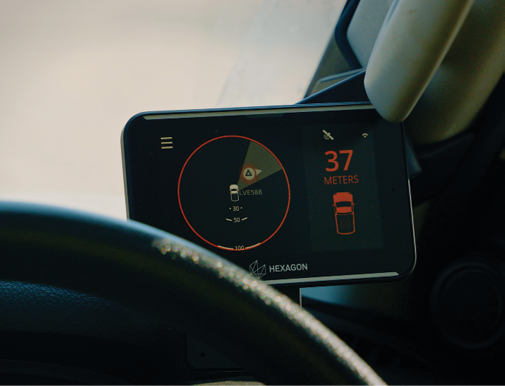
A key step forward: MTU
Hexagon’s work took another giant leap forward in December 2025 when the company signed an agreement with Montana Technological University, granting access to the university’s Underground Mine Education Center (UMEC), including its training drifts and specialised equipment. Under the agreement and pact, Hexagon gained real-work environment capabilities for its testing of underground technologies, particularly collision avoidance, operator safety, and advanced simulation.
“As mines expand deeper in pursuit of scarcer deposits, operators face tightening spaces, reduced visibility, and rising safety risks. Hexagon’s solutions already address fatigue, situational awareness, and underground development challenges,” the company said in December.
Goddard stressed that the work with the university offers an unprecedented proving ground to accelerate life-saving innovation.
“At the same time, we’re helping future miners engage directly with the tools reshaping their industry. It’s a partnership that advances safety, technology, and talent,” he added.
UMEC’s full-scale mine environment enables rigorous testing of sensors, algorithms, and operator-machine interactions. Hexagon will use the site for simulation, validation, training, and demonstrations, helping bridge the gap between laboratory development and operational deployment while strengthening industry-academic collaboration.
Hexagon’s broadening role
Goddard told NAM that collision avoidance is not a standalone feature; it is foundational. It is the starting point for building trust in connected systems and for creating operations where digital intelligence actively protects people in real time.
“From that safety foundation, we help customers optimise the entire mining value chain – every drill hole, blast, bucket movement, and processing step generates data, but too often that knowledge is siloed across fleets, vendors, and departments,” he said.
“By connecting workflows across geology, planning, operations, and processing, we ensure that insight flows as seamlessly as material does. We are working towards a living, continuously evolving digital representation of the mine that links long-term plans with day-to-day execution, enabling better decisions that improve not only productivity and recovery, but also risk management on the ground.”
Both he and Hexagon are proud of the fact that its changing system is OEM-agnostic and open, as it is the reality of many mines today. Mines operate mixed fleets and diverse technology ecosystems, and safety systems must work across all of them.
“By connecting technologies without imposing walled gardens, we enable consistent collision avoidance, situational awareness, and decision support across equipment types and vendors. The result is an operation that does not have to choose between safety and performance — where protecting people and optimising value are part of the same integrated system.”
When it came time to integrate ahead of last July’s announcement, it all simply made sense and was what Goddard called a “deliberate step” to creating a more unified and contextualized safety ecosystem. It was also a goal of Hexagon to put the system into a field test with a customer, so a perfect opportunity came to light with Whitehaven.
Since July, over 10 customers across different regions (including Australia, Colombia, Chile, and Canada) have followed suit and upgraded to OAS 7.5.
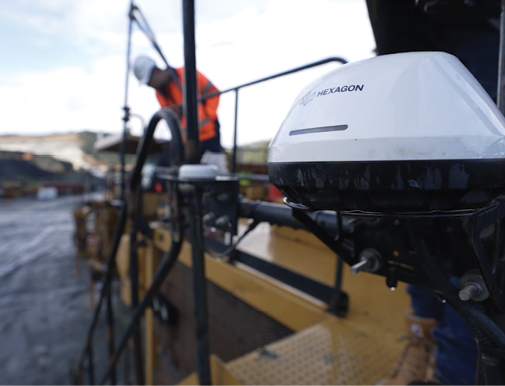
Making it all work: an inside look
Goddard pointed out that the integration went to the inside and worked outward; that is, rather than adding further hardware into already complex cab environments, the integration was executed at the server level. There was no need for mines to acquire additional onboard equipment, as systems already installed in the fleet are able to be connected remotely with minimal disruption.
“Historically, collision avoidance and operator alertness have often operated alongside each other as separate systems. The integration changes that dynamic. It allows mines to move beyond viewing safety technologies as parallel tools and instead manage them as a single, cohesive operator safety platform,” he noted.
“Collision avoidance events can now be understood in the context of fatigue, operator behavior, overspeeding, and GNSS-related data. In practical terms, this elevates CAS from being primarily an alert-based system inside the vehicle to becoming part of a broader, contextual safety framework that supports both real-time decision-making and longer-term risk reduction.”
A key opportunity created by the integration, then, lies in the depth of insight it provides. Historically, collision data was analyzed through trends, heat maps, and event counts to establish KPIs and identify high-risk zones.
However, combining CAS data with OAS video footage makes events tangible and easier to interpret. Said Goddard: “Safety teams can review predicted collision events alongside visual context, helping them understand root causes, validate alarms, tune system settings, and conduct more informed investigations. The result is a shift from reacting to isolated alerts towards proactively managing systemic risk.”
At the same time as the integration, mine safety was at the heart of another crucial move for Hexagon: the launch of ArcSAR Neo system.
In January of this year, IDS GeoRadar, part of Hexagon, launched the ArcSAR Neo system to strengthen slope-risk management and mine safety.
Unlike other existing GB SAR systems, which map two-dimensional radar data into three-dimensional models, ArcSAR Neo captures three-dimensional information directly during monitoring operations.
Between radar data clarity with reduced interference and clarity in monitoring results, operators gain greater confidence in alerts and trend analysis, supporting faster, more reliable safety decisions and reducing unnecessary operational interruptions.
ArcSAR Neo’s 360-degree camera with HDR imaging offers high-quality, georeferenced panoramic imaging synchronized with 3D radar data, permitting valuable visual context to support the interpretation of monitoring data.
ArcSAR Neo can function entirely on solar energy thanks to its photovoltaic panels. However, for continuity in situations where sunlight is less available, users can choose to run the system on diesel.
ArcSAR Neo is available in three different configurations (Tactical, Advance and Performance) to suit the size and strategic requirements of slope monitoring operations – from small pits to the largest open-pit mines – with a simple license change.
Transitional goals, looking ahead
Goddard said the system’s release fits squarely into Hexagon’s broader transition toward integrated, proactive risk management.
“While CAS and OAS focus on vehicle interactions and operator alertness, ArcSAR Neo strengthens slope stability and ground risk monitoring by delivering faster, higher-resolution radar insights for early detection of movement. In both surface and underground contexts, the goal is the same: move from reactive response to predictive awareness,” he noted.
“By combining real-time vehicle safety, operator monitoring, and geotechnical intelligence into a connected ecosystem, Hexagon is building a safety architecture that addresses multiple risk layers simultaneously – from haul road interactions to pit wall stability – grounded in the same philosophy of early detection, contextual insight, and decisive action.”
He also confirmed that the company’s move into underground collision avoidance was not a sudden pivot, but the natural progression of work that has been underway for some time.
As surface deposits mature and operators push deeper to access new resources, underground environments are becoming more complex, with tighter spaces, reduced visibility, and increased interaction between people and machines, and that shift demands a different safety architecture.
“Through the acquisition of indurad and the continued development of its advanced, RTLS (real-time location system) based collision avoidance and personnel safety system, Hexagon has been investing heavily behind the scenes in radar-based, infrastructure-light technologies specifically suited to underground conditions,” he noted. Its work since has built on those years of research and development, incorporating ultra-wideband capabilities, advanced tracking methods, and improved reliability to reduce false positives and increase operator acceptance.
“Importantly, this development has not been theoretical. indurad’s RTLS-based system has already been deployed in underground mines in Germany, operating peer-to-peer and often without requiring new infrastructure,” he added.
What’s ahead for the next generation of its technology? The addition of contextual event replay and camera integration, allowing sites to see exactly what occurred around a machine during an event, which strengthens both safety management and learning.
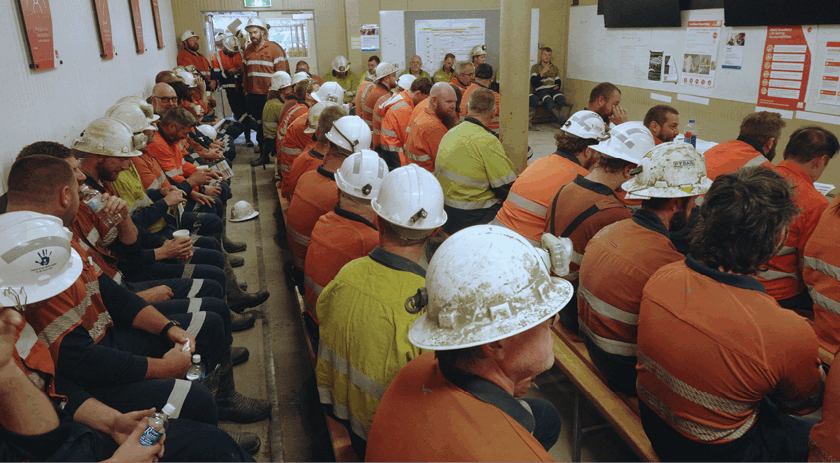
Optimized mining: Hexagon’s mind’s eye
So, looking at the pieces in whole, what does the optimized mine look like using Hexagon’s technology? Goddard said the optimal mine is one where every movement of material and every movement of a machine is understood in context, in real time.
“The operation is anchored by a living digital twin – not a static model, but a continuously evolving representation of geology, planning, equipment, and processing working as one system. Every block of material carries its digital identity forward as it moves through the value chain, and every interaction – from drill to blast to haulage to plant – refines that understanding.
“In that environment, safety systems such as collision avoidance and operator alertness are not bolt-ons; they are embedded layers of intelligence that both protect people and enrich the broader decision-making framework.”
It is key to keep in mind that, critically, the future must be equipment-agnostic and open by design, he stressed. Again, mines operate mixed fleets and diverse technology stacks, and value is lost when systems are confined to walled gardens.
“When mining and processing are synchronized and informed by shared, trusted data, long-term planning and short-term execution align around the same economic, safety, and sustainability goals. Ultimately, it is about turning context into action – enabling safer operations, more resilient performance, and the ability to unlock value from resources that might otherwise remain uneconomic.”
Whitehaven, where Hexagon’s OAS and CAS technologies were tested, said a successful trial came from genuine collaboration, innovation, and a shared safety drive.