
Choosing the right equipment for crushing and grinding processing circuits is a multi-pronged process.
by Steve Sewerniuk
As demand for critical minerals and industrial materials continues to rise, operators in the lithium, fertilizer (potash, nitrogen, phosphates), gypsum, salt and other minerals industries are under increasing pressure to improve throughput, reduce energy consumption, and maximize yield. In soft rock applications, especially, selecting the right crushing and grinding equipment is no longer simply a matter of achieving target product size. The decision directly impacts operating costs, fines generation, maintenance requirements, and overall plant efficiency.
Modern processing circuits must balance productivity with product quality while handling changing feed characteristics. For producers working with friable materials, excessive fines can reduce recoverable product, increase recirculating loads, accelerate wear, and create downstream challenges.
Here is why successful operations focus on optimizing process flow and equipment selection to reduce fines generation and maximize product recovery.
Understanding the challenges of soft rock processing
Soft rock materials present a unique set of processing considerations compared to harder ores. While these materials are generally easier to reduce in size, they are also more susceptible to over-crushing and degradation. Excessive fines can create significant problems in screening, conveying, storage, wear from recirculation, and ultimately product recovery.
In potash operations, for example, maximizing first-pass recovery of granular product in the 2.3–4.7 mm range is essential, as fines must be recirculated back to the compaction circuit, reducing fresh feed capacity and increasing wear throughout the system. Salt producers are also held to tightly controlled product sizing specifications for applications such as road salt and benefit from controlled top size and reduced fines generation, which also helps minimize dusting.
Lithium processing has become an especially important area of focus as demand for batteries and energy storage systems accelerates worldwide. Producers are seeking ways to improve liberation efficiency while minimizing energy consumption across crushing and grinding circuits. Equipment capable of delivering consistent feed to downstream beneficiation processes plays a critical role in improving overall plant performance.
Importance of controlled size reduction
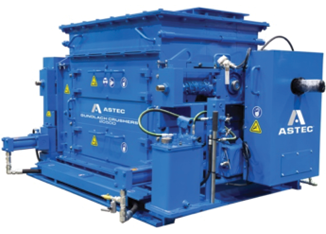
One of the most important considerations in crushing circuit design is achieving the desired reduction ratio without creating excessive fines. High-speed impact crushers and hammermills can provide aggressive reduction, but they often generate unnecessary fines and consume more power in the process. Double-roll crushers, by comparison, use primarily compression as well as shear to break material in a more controlled manner. This allows operators to achieve a more uniform product while reducing energy demand and wear.
Double-roll crushers are designed specifically around the principle of controlled size reduction. Their various roll profile designs and adjustable roll gaps allow the units to be configured for specific applications to maximize product yield. In a single-stage, two-roll configuration, reduction ratios up to 4:1 can be achieved, while some manufacturers offer four-roll, two-stage units capable of reaching reduction ratios up to 16:1. These machines provide significant size reduction while maintaining precise top-size control and minimizing fines generation.
This is particularly valuable in applications where first-pass product directly affects profitability. In soft rock applications, the goal is to maximize saleable product from every ton processed.
Energy efficiency and operating costs
Energy efficiency continues to be a major driver in equipment selection decisions. Crushing and grinding circuits are among the most energy-intensive operations in mineral processing plants, often accounting for a substantial portion of total plant power consumption. Equipment that minimizes over-crushing can significantly reduce recirculating loads, lower wear rates, improve saleable product yield, and optimize overall circuit efficiency.
Single- and two-stage double roll crushers are well-suited for this role because they apply force more efficiently to the material. Roll crushers typically consume substantially less horsepower per ton compared to many impact-based crushing systems while still delivering high throughput capacities.
This lower energy demand provides several advantages:
- Reduced energy consumption
- Less dust generation
- Reduced wear on overall circuit equipment
For operations facing rising electricity costs or sustainability targets, these benefits can significantly improve long-term profitability. In many applications, upgrading to roll crusher technology can achieve payback within only a few years while also reducing recirculating loads and improving screening efficiency.
Matching equipment to material characteristics
Selecting the right crusher requires a detailed understanding of the material being processed. Key considerations include:
- Feed size
- Desired product size
- Throughput
- Moisture content
- Abrasiveness
- Compressive strength
- Bulk density
Changing feed characteristics can affect crushing circuit performance depending on the selected crusher technology. Elevated moisture content may create buildup issues in certain crushers, while roll crushers are generally less susceptible to plugging and can handle wet, sticky materials more effectively. Tramp relief systems can also allow most uncrushable material to pass through without causing significant damage.
In potash applications, specialized fine grinding equipment such as Gundlach’s Nanosiz-R has been widely implemented in new circuits and plants to produce targeted 2.3–4.7 mm product with minimal fines generation, strong top-size control, and up to 4:1 reduction ratios.
Similarly, gypsum producers often require crushing equipment capable of handling variable feed characteristics while maintaining a consistent product size suitable for calcining or wallboard production. The ability to customize roll configurations, tooth profiles, and gap adjustment systems allows operators to optimize crushing performance for specific material properties and downstream process requirements.
Reducing downtime through equipment design
Maintenance considerations are another critical factor when evaluating crushing and grinding equipment. Unplanned downtime can quickly become one of the largest hidden costs in mineral processing operations. Modern equipment designs increasingly focus on simplifying maintenance procedures and improving service accessibility.
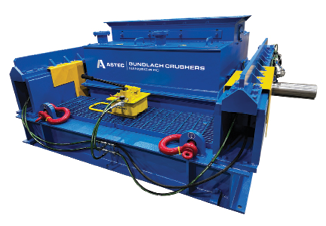
Derrick Jansen, senior engineering manager at Astec, noted that features such as coupling-mounted rolls, split housings, and accessible lubrication systems can reduce maintenance time and improve safety during service operations. Gundlach Multi-Roll Crushers use coupling-mounted rolls that allow faster replacement without disturbing main bearings, shafts, and drives, helping reduce downtime and extend equipment life.
Tramp metal protection is another important consideration, especially in mining operations where uncrushable material may occasionally enter the crushing circuit. Hydraulic and nitrogen-based relief systems can help protect critical components while minimizing the risk of catastrophic equipment damage.
These features contribute not only to equipment longevity but also to more predictable maintenance scheduling and lower lifecycle costs.
The role of feeding and material distribution
Even the best crusher design cannot perform effectively without proper feeding conditions. Uneven feed distribution can lead to inconsistent product sizing, accelerated wear, and reduced throughput.
Successful crushing operations pay close attention to material flow entering the crusher. Properly designed chute work or the incorporation of vibratory feeders helps distribute material evenly across the full width of the rolls, maximizing throughput and minimizing wear.
This becomes particularly important in high-capacity mining applications where maximizing throughput and minimizing wear are ongoing priorities.
Building more efficient processing circuits
The most successful crushing and grinding circuits are designed as integrated systems rather than isolated pieces of equipment. Every stage of size reduction affects downstream performance, from screening and conveying to further size reduction.
Careful equipment selection can improve:
- Product consistency
- Recovery rates
- Energy efficiency
- Maintenance planning
- Dust control
- Overall plant uptime
For soft rock applications, roll crushers using compression-style crushing offer greater precision and control than high-speed impact crushers, which can generate unnecessary fines. Roll crushers improve top-size control and create a more predictable product output, helping maximize usable product yield and overall plant efficiency.
By selecting equipment specifically designed for the material and application, producers can build processing circuits that deliver long-term reliability, lower operating costs, and improved profitability. As global demand for industrial minerals, fertilizers, and critical minerals continues to grow, the importance of efficient, reliable crushing and grinding systems will only increase. Producers who invest in properly matched equipment today will be better positioned to meet future production demands while maintaining operational efficiency, minimizing waste, and improving product quality.
About the author: Steve Sewerniuk is global director of Mining for Astec Industries.