
Metso and Loesche believe so, having recently partnered to launch the Metso Loesche VRM across a variety of mineral processing applications. North American Mining spoke with Tim Robinson and Christoph Hoetzel of Metso about the collaboration, the technology, and what comes next.
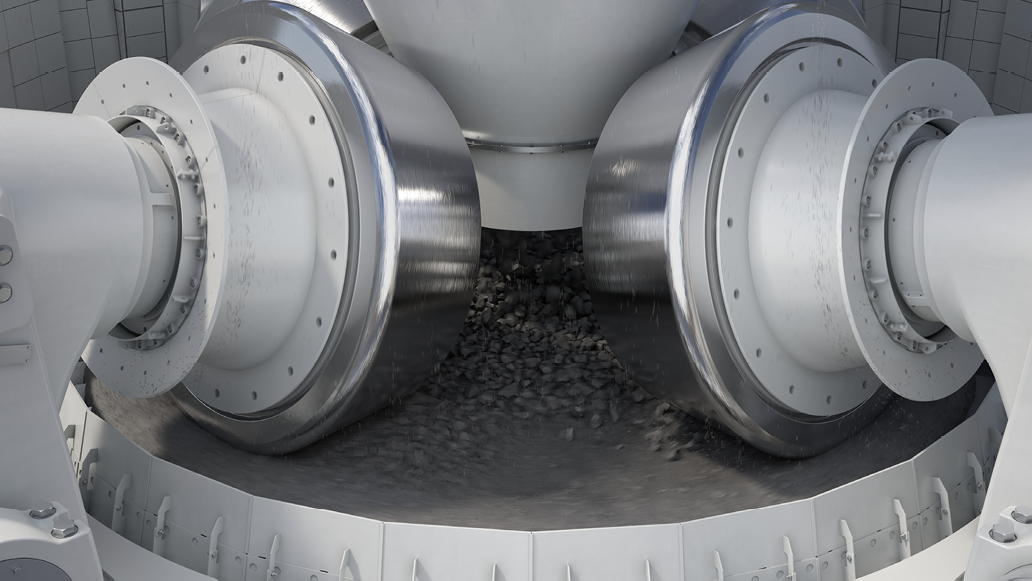
Grinding accounts for a large share of energy consumption at most mineral processing operations – and, in many cases, it is also where water demand is highest and circuit complexity greatest. The combination has made comminution optimization a persistent industry preoccupation. Enter the Metso Loesche VRM. “Vertical roller mills fundamentally change how grinding and classification are combined, opening a different performance perspective compared to traditional concepts,” said Christoph Hoetzel, senior vice president for Grinding at Metso.
The partnership between Metso and the German-based VRM specialist Loesche combines what Hoetzel described as complementary strengths. Loesche brings more than a century of VRM design and operational experience, with a reference base of over 2,400 installations running at large industrial scale worldwide. Metso contributes depth to mineral processing: ore characterization, flowsheet development, and the engineering and service infrastructure required by mining projects. “Together, we close the gap between industrial VRM technology and the practical requirements of mining applications,” he said.
The timing of the partnership is also deliberate. Rising energy costs, water constraints, emissions targets, and tighter permitting are now directly influencing project design decisions. “With many projects – particularly in North America – at early planning or rebuild stages, this is exactly the right moment to bring VRMs into the mainstream flowsheet conversation,” added Tim Robinson, Metso vice president of Mineral Sales in North and Central Americas.
At the same time, VRM technology has matured, with advances in wear protection, control, and operational stability enabling reliable performance in harder ores and higher throughputs, Robinson continued. “By aligning on joint R&D, testing, and go-to-market execution, we can offer a VRM solution that is optimized for mining from the outset, reducing technical and commercial risk for owners and EPCs.”
WHERE THE TECHNOLOGY FITS
According to Hoetzel, VRMs are “particularly well suited to hard-rock ores that require a fine and well-controlled product size distribution for downstream beneficiation,” with high reduction ratios of 3000:1 possible in a single stage.
The technology combines grinding and classification into a single unit, reducing circuit complexity, plant footprint, and auxiliary equipment requirements: factors that can materially affect both capital cost and permitting timelines when they are considered early rather than retrofitted later.
According to Robinson, these factors suggest two distinct entry points for VRMs in mineral processing. The first is greenfield projects and circuit redesigns, where sustainability and energy constraints are becoming decisive influences on project economics and permitting.
The second application is brownfield debottlenecking. In existing SAG-based circuits, VRMs can be deployed as pebble grinding solutions, taking material that would otherwise recirculate, increasing throughput without major plant expansion, and grinding pebbles to flotation-relevant fineness for direct downstream processing. It is a “practical entry route for operations looking to improve performance within an existing footprint,” Robinson said.
DON’T VRMS HAVE A WEAR PROBLEM?
Industry familiarity with VRMs in cement has shaped – and, Hoetzel suggested, distorted – expectations about their suitability for harder feed. “VRMs are commonly used in cement due to the need for dry processing,” he said. “But our test work database on hard ores suggests that the optimized wear part configuration of the Metso Loesche VRM can outperform many conventional comminution mechanisms.”
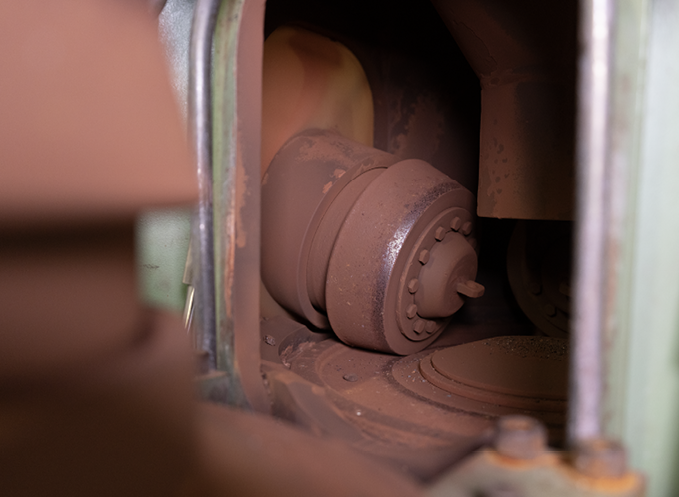
Wear protection concepts have been specifically reviewed, tested, and, where necessary, further developed for hard-rock conditions as part of the Metso-Loesche collaboration, covering wear part design, material selection, and operating strategies. Hoetzel cited availability levels above 90% from operational data, “comparable to, and in some cases higher than, conventional grinding technologies,” with Metso’s global service network positioned to provide parts and technical support wherever a mill is operating.
CONSERVATISM? WHAT CONSERVATISM?
As Loesche’s long history implies, VRMs are hardly a new technology. Yet, using VRMs at the scale and hardness typical of North American mining projects remains a relatively unfamiliar proposition. Is there not a risk that, amid the mining industry’s famed conservatism, the technology will always remain a niche proposition for specific applications?
Robinson preferred to reframe the question. “One thing we asked ourselves is whether it is truly conservatism, or whether it is more related to the business case,” he said. “Mining projects must consider risks and mitigations when technologies are selected. The challenge has always been finding a solution that meets both the technical and commercial requirements.”
Hoetzel drew a parallel to HPGRs, a technology that spent years on the margins before achieving selective acceptance – but that still attracts scrutiny over total installed cost.
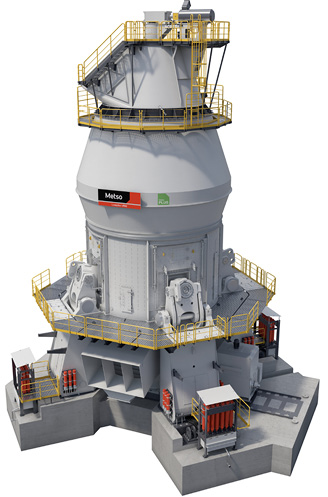
In contrast, VRMs address the friction points of traditional circuits in ways that more complicated HPGR solutions do not, offering energy efficiency, a compact footprint, a simplified circuit, and a competitive total cost.
“VRM technology is rapidly becoming a superior option in the early stages of flowsheet selection over an HPGR dry finish grinding circuit with air classification,” he concluded.
COMING SOON TO A MINE NEAR YOU
Early market response has been encouraging, according to Robinson, who mentioned positive reactions from both mining operations and engineering firms.
Interest has been particularly notable in copper, gold roasting, nickel, and rare-earth concentrator applications, driven primarily by energy and water savings.
“We are already discussing applications with many of our larger customers,” he said, “while many of the more progressive engineering firms are actively seeking reference data and test work results.”
Metso’s own flotation and separation specialists have also become advocates for the technology, recognizing that VRM product characteristics can improve downstream recovery. “That has all our teams very excited for the future,” Robinson concluded.
About the Metso-Loesche partnership
Announced in May 2026, the Metso-Loesche partnership combines Metso’s expertise in sustainable, end-to-end minerals processing and extensive service capabilities with Loesche’s vertical roller mill technology to deliver VRM dry grinding for a wide range of mineral processing applications.
The Metso Loesche VRM is part of the Metso Plus offering – a portfolio of more than 100 products and services designed to help customers reduce CO2 emissions, improve process efficiency, and achieve broader sustainability targets. According to the company, Metso Plus products are developed to deliver meaningful reductions in both direct emissions and those associated with manufacturing and operations, ensuring they can make a measurable difference to customers’ climate and environmental goals. With 80% of Metso’s R&D spend targeted at Metso Plus development by 2030, the portfolio is set to expand to cover every part of the minerals processing value chain.
The Metso Loesche VRM dry-grinding technology can replace HPGRs, horizontal mills in primary and secondary applications, and tertiary stirred mill applications, which simplifying the process and reducing energy consumption and operating costs.
Downstream processes benefit from improved mineral liberation and a steeper particle-size distribution. Advanced flowsheets incorporating coarse particle flotation, magnetic separation, or other coarse beneficiation technologies can also be facilitated, further reducing – or even eliminating – water consumption where fully dry processes are feasible.