
For decades, measuring a crusher’s open-side setting has been a manual job – imprecise, infrequent, and not without risk. North American Mining spoke with Ingo Neitemeier and Jayachandran Manoharan at FLS about a new technology that aims to change this.

Open-side setting – or OSS. It is one of the most influential parameters in crusher performance, impacting the efficiency of the entire process. Even small deviations can materially affect downstream product size, energy consumption, and liner life. And yet, in most operations, verifying it still means sending someone to the crusher with physical tools, be it a foil ball, a pressure ball, or a measuring instrument, while the machine runs in idle.
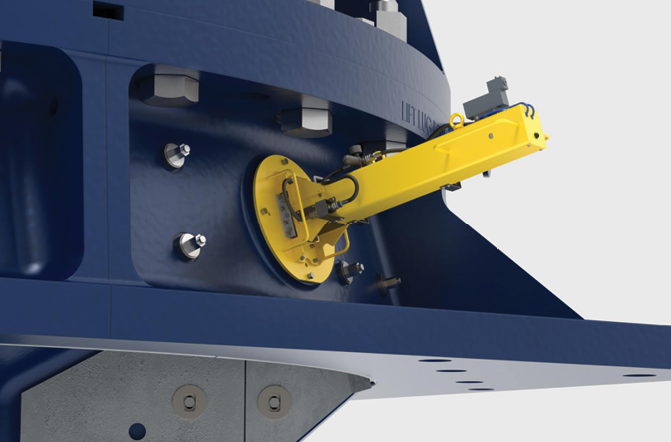
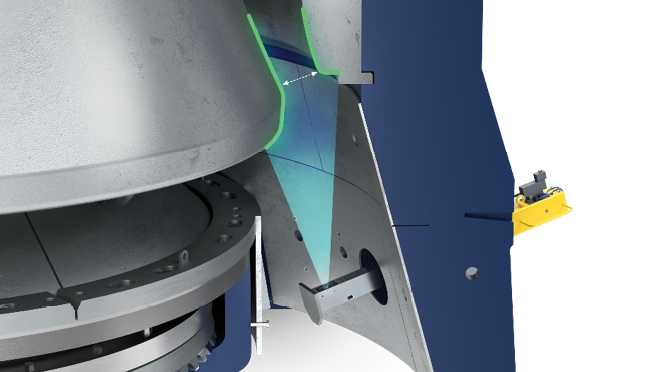
FLS CrusherLensIQ is a new camera-based answer to that problem. The system is installed through the porthole in the bottom shell of a gyratory crusher. When a measurement is needed, the camera extends into the crusher – which must be idling (no load) – to measure the distance between the concave and the mantle. It then sends a reading to the operator’s screen before retracting. According to the company, the entire cycle is completed within 30 seconds. When the crusher is running under load, the camera remains fully retracted inside its protective housing.
“The system is designed to operate safely and reliably in a very harsh crushing environment while avoiding the need for manual OSS measurement methods,” said Ingo Neitemeier, global service line manager for Gyratory Crusher Consumables at FLS. Camera movement is controlled either from the control room via the PLC or locally from a dedicated unit near the crusher. In either case, Neitemeier continued, the operator does not need to approach the machine to take a measurement.
SAFETY AND MEASUREMENT RELIABILITY
This has obvious implications for operator safety, as Neitemeier explained.
“Traditional OSS measurements require personnel in the crusher area when the crusher is running in idle. CrusherLensIQ eliminates these manual inspections. The OSS can be verified remotely, without sending personnel into hazardous areas.”
Neitemeier also pointed to measurement consistency as another aim of the system’s development. Manual methods are inherently variable: physical tools deform, are inconsistently positioned, and produce a single data point per inspection. In contrast, CrusherLensIQ measures against the same reference geometry every time and records the result digitally, enabling trend analysis over time. “Field tests show significantly improved repeatability and transparency,” he said. “More frequent, reliable measurement also allows operators to act on what the crusher is actually doing rather than what it is nominally set to do.”
“Customers have responded positively to the ability to validate settings after adjustments with confidence,” Neitemeier concluded, “rather than relying on subjective measurements or doing it by experience.”
RETROFIT AND INTEGRATION
FLS positions CrusherLensIQ as retrofit-friendly. Provided a crusher has suitable mounting locations – port holes in the bottom shell – and adequate line-of-sight conditions, explained Jayachandran Manoharan, R&D project manager, Consumables, the system can be fitted to older machines and, in many cases, to third-party equipment. On the integration side, it is designed to interface with common plant automation architectures, making OSS data available to the control room alongside other process variables, including power draw, throughput, and product size.
Beyond the control system, CrusherLensIQ fits naturally into FLS’s broader digital and optimization ecosystem, according to Manoharan, “where it can serve as a data source for performance monitoring, wear tracking, and advanced advisory tools.”
NEXT STEPS
Looking ahead, Manoharan described CrusherLensIQ as a building block rather than an endpoint. “The next development focus is tighter integration,” he said, “deeper connection with crusher control strategies, automated alerts when OSS drifts from target, and the fusion of OSS data with wear profiles, power draw, and throughput figures. The focus is on closing the loop between measurement, interpretation, and action.”
More broadly, both Neitemeier and Manoharan see primary crushing moving toward data-driven operation: a direction, they argue, that depends on replacing periodic manual checks with continuous, reliable measurement.
“Technologies like CrusherLensIQ reduce reliance on assumptions and manual intervention, replacing them with continuous insight,” Manoharan concluded. “Digital solutions must deliver practical value on site. CrusherLensIQ was developed with operators and maintenance teams in mind – solving real safety, reliability, and consistency challenges rather than adding complexity.”