
The Mine Safety and Health Administration recently released a fatality alert to all mines across the U.S. following a January 6 incident that killed a contract worker in California.
In that incident, which occurred at the Lebec cement plant, a contractor was fatally struck by the motor and gearbox assembly while removing a baghouse slide gate.
The facility is owned by Vicat SA.
The agency issued a series of best practices for miners, including blocking machinery or equipment against hazardous motion before beginning maintenance or repairs and verifying miners are in a safe location and away from potential “red zone” areas. Additionally, MSHA stressed securing assemblies to prevent unexpected movement and using proper tools to identify and control all stored energy sources, including gravity.
It is also asking mines to train its miners in safe work procedures and hazard recognition.
This was the first fatality reported this year, and the first to be classified as Machinery. A final report of the fatality and incident is pending.
To report accidents and hazardous conditions, MSHA’s hotline is 1-800-746-1553.
MSHA releases final report from June 2025 fatality
Federal regulators recently released their findings from a fatal incident involving a maintenance worker in June 2025.
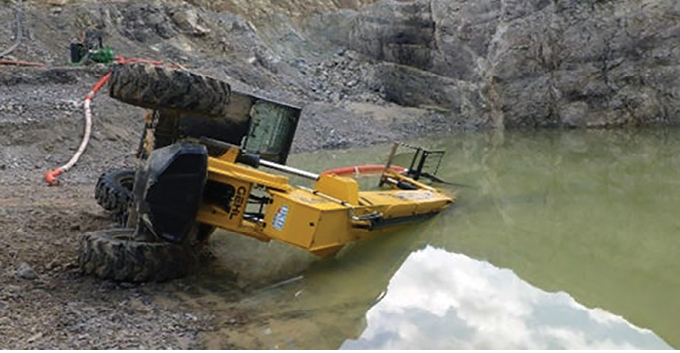
MSHA said John Bird, 41, who had one year and 28 weeks of mining experience, died when a telehandler overturned onto him. The accident happened at the Coleman quarry in Atoka County, Okla.
The surface crushed stone mine employed 11 miners and operated one 12-hour shift, six days per week. P&K contracted RPMX Construction to extract the stone from the pit by blasting the stone and using excavators to load haul trucks. Bird was an employee of P&K.
Specifically, the telehandler rolled over onto its right side and landed on Bird while he was outside the operator’s cab.
The accident investigation team conducted an analysis to identify the underlying causes of the accident. The team identified the following root causes, and the mine operator implemented the corresponding corrective actions to prevent a recurrence.
First, the mine operator allowed the miner to work alone without communication while checking the pump in the quarry pit. As a corrective action, the mine operator developed and implemented a procedure to ensure that no miners or contractors work alone. The mine operator has trained all miners on this procedure.
Second, the mine operator used the telehandler beyond its designed capacity. The mine operator has since retrained all miners on the telehandler’s safe operating procedures according to the operator’s manual.
Third, the mine operator did not provide newly hired experienced miner training. Since then, the mine operator retrained mine management on the requirements of 30 CFR Part 46.
Finally, the mine operator did not ensure the boom and outriggers were positioned to prevent movement of the telehandler. As a corrective action, the mine operator trained all miners on safe parking procedures.