
Explorer American Rare Earths, which is advancing its Halleck Creek project in Wyoming, confirmed this week that it had produced rare earth oxides from its ore using an updated preliminary pre-feasibility study mineral processing flowsheet.
The company said a mixed rare earth oxalate and mixed rare earth oxide were created from purified leachate solution using the material from impurity removal testing – a turn in the project’s journey that it has called its most significant technical milestone to date.
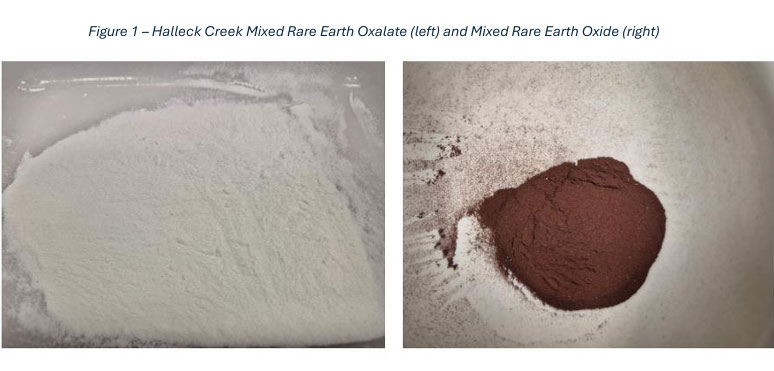
“[This] confirms that rare earths can be extracted into metallic oxides from Halleck Creek ore using the updated…flowsheet currently being finalized for the upcoming PFS. Solvent extraction computer simulation is now underway using the results of these tests,” officials said, noting that the work is a two-step process being performed by its partner SGS from Lakefield, Ontario, Canada.
The first step of the process consists of precipitating the metals in solution using oxalic acid to create a mixed rare earth oxalate. Oxalic acid is highly selective in precipitating rare earth elements from PLS while other elements stay in solution. SGS performed three precipitation tests using variable oxalic acid addition rates.
The second step, called calcining, involved SGS heating the combined mixed rare earth oxalates to 1,000oC to oxidize the material into a MREO. A beneficial effect of calcining is that it oxidizes the cerium, converting it from Ce3+ to Ce4+. Ce4+ is not soluble in the reagent, which will be used to dissolve REEs from the MREO for solvent extraction.
MREO is the precursor used to produce individually separated rare earth products through solvent extraction, such as neodymium-praseodymium, terbium and dysprosium. In general, producing MREO is the most challenging technical step in manufacturing separated rare earth oxides.
Next for Halleck Creek, it said, is the solvent extraction simulation, using MetSim, which is now underway using the analytical results of the MREO, and process optimization using bulk samples, which is ongoing alongside its metallurgy work.
Comminution testing of test pit ore, from the Cowboy State Mine area, is nearing completion at FL Smidth and Loesche. Bulk ground material from the comminution testing is scheduled for reflux classifying concentrator separation and induced roll magnetic concentration at Nagrom. Additional wet high-intensity magnetic separation of fines <53µm is scheduled with Eriez.
Halleck Creek’s resource has the potential to secure the heavy and light rare earths needs for U.S. permanent magnets for more than a century.
It is being developed in two phases: the Cowboy State mine and development of Halleck Creek on federal land and minerals, which has an 80-year-plus mine life potential.
Source: American Rare Earths