
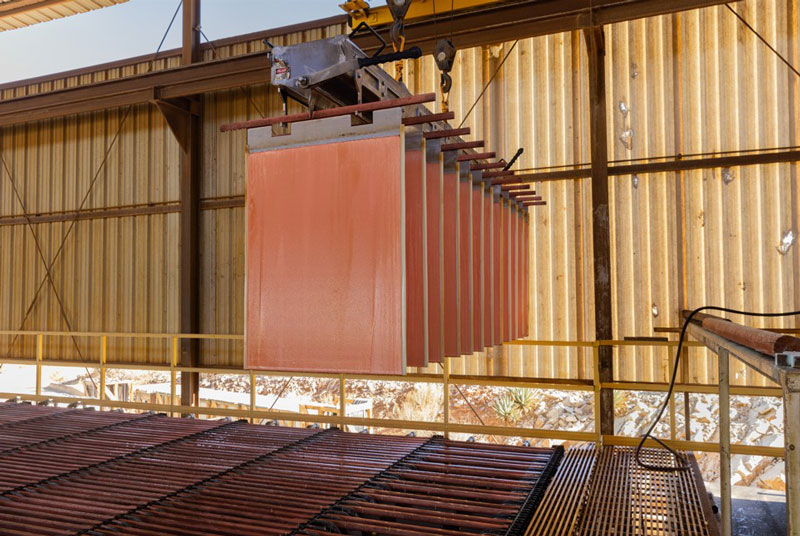
After more than 30 years of research and development, the first copper cathode using Rio Tinto’s Nuton technology, a proprietary bioleaching process that relies on microorganisms grown on site, was produced at Gunnison Copper’s Johnson Camp mine in Arizona last month.
“This is a breakthrough achievement for our Nuton technology, which is proving that cleaner, faster, and more efficient copper production is possible at an industrial scale. In an industry where projects typically take about 18 years to move from concept to production, Nuton has now proven its ability to do this in just 18 months,” said Rio Tinto Copper Chief Executive Katie Jackson.
“Nuton has designed a modular system deployed as a technology package integrating biology, chemistry, engineering, and digital tools, allowing it to be rapidly scaled and tailored to different ore bodies, unlocking resources that have historically been considered uneconomic or challenging. We are actively partnering on projects in North and South America to assess the potential for future deployment at additional sites in the coming years.”
The deployment involves the design and delivery of a technology package for a heap leach pad targeting production of approximately 30,000 tonnes of refined copper over a four-year demonstration period. The copper produced is anticipated to have a mine-to-metal carbon footprint of 0.82-kilogram CO₂-e per kilogram of copper, the lowest in the U.S. and substantially lower than the projected 2026 global average of 3.4 kg CO₂-e/kg of copper among operating mines.
While this milestone confirms Nuton’s engineering and operational viability, the next phase will focus on validating long-term technical performance. This includes multi-year testing, independent third-party verification, and internal review by Rio Tinto to ensure consistent recovery rates and environmental performance.
Source: Rio Tinto