
From seam to surface, Core Natural Resources’ Enlow Fork operation in Pennsylvania is an example of longwall leadership. North American Mining magazine was recently invited to be part of an exclusive tour of the engineering and technology that has gone into its success.
by Donna Schmidt
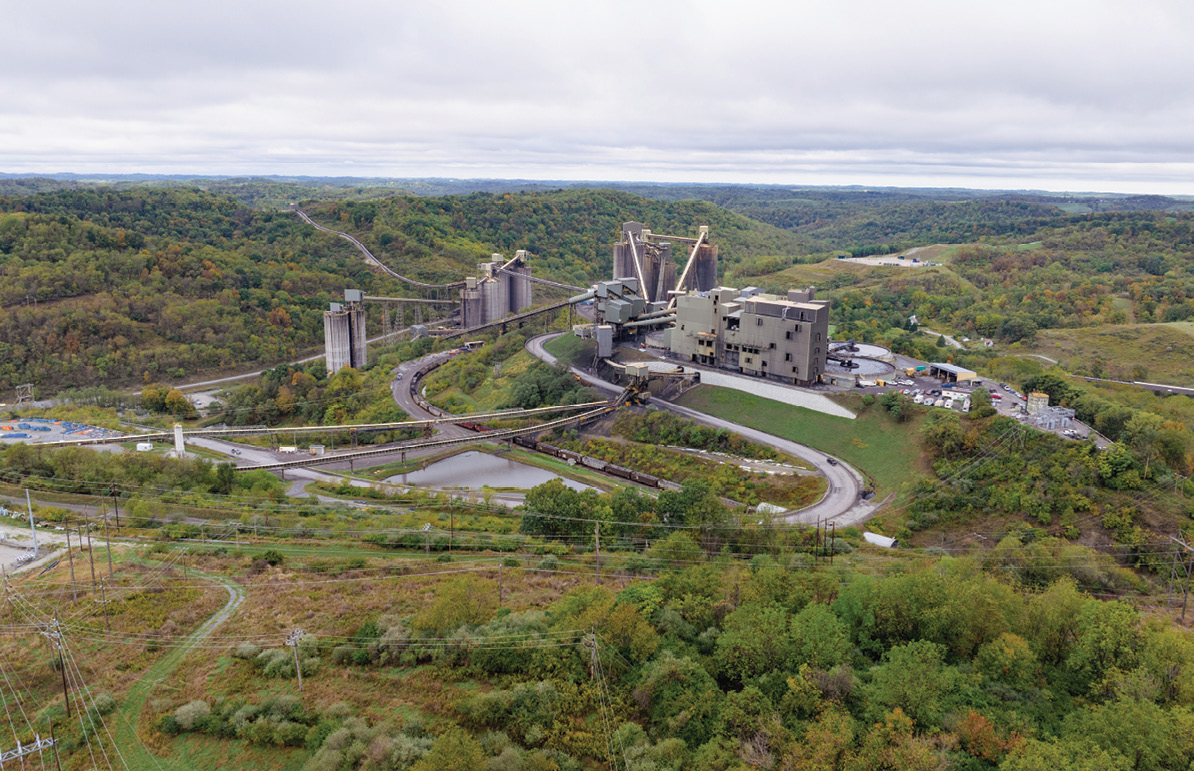
As coal mines go, longwalls are arterial elements of the production picture. And with significantly fewer longwall faces today than even just 25 or 30 years ago, their place in coal mining has never been more vital.
The prolific Pittsburgh No. 8 Coal Seam, which is known for its high-rank tonnage, is home to a number of these longwalls. Among the most productive of the group is Core Natural Resources’ Pennsylvania Mining Complex (PAMC), which consists of a trio of large-scale operations – the Bailey, Harvey and Enlow Fork mines. Together, they hold production capacity of nearly 28.5 million clean tons annually and have reserve tons exceeding 584 Mt.
Enlow Fork, located in Prosperity, Washington County – less than one hour from the city of Pittsburgh – is a long-standing stalwart in not only Core’s portfolio, but also in the region where it operates. What’s more, it is not going anywhere for a while, with management estimating its lifespan will continue for years to come.
About Enlow Fork
Location: Washington County, Pa.
Seam name: Pittsburgh No. 8
Seam height: 90 inches
Depth of cover: approximately 800 feet at the portal
Number of longwalls: 2
Total annual production: 10 million tons
Digging into the details
Enlow Fork, developed next to sister mine Bailey, first kicked off commercial production in 1989 and its first longwall panel came online two years later. A second longwall followed in 1992.
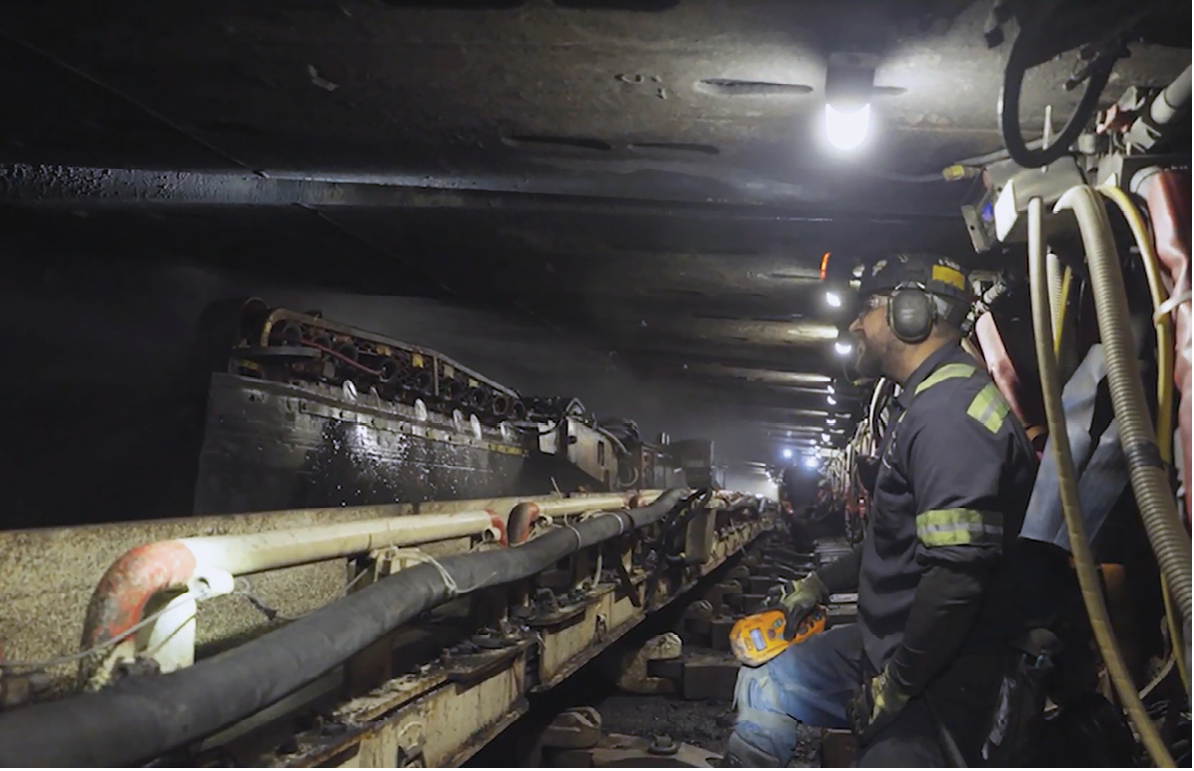
The longwall active at the time of NAM’s tour was brand new, with a Komatsu 7LS1D shearer cutting a 42-inch web (a total of three are kept on hand for optimal availability), 240 FAMUR hydraulic shields with 969-ton yield pressure supporting the current face. LW Associates supplied the panline on the current face, and the longwall takes about eight full passes per shift.
Longwall cutting height at Enlow Fork is approximately 96 in. on average, and consistent with current conditions at the active face. Continuous miner cutting height is similar, also about 96 in., and the average height of the main bench coal seam throughout Enlow Fork is 62-72 in.
Supporting development typically includes 6 Joy-Komatsu 14ED25 or Sandvik MB450/451 continuous miner-bolters along with an auxiliary fleet of Komatsu 14BU27 loaders, 10SC32 shuttle cars, and Stamler/Joy feeders. It uses its continuous miner fleet for gate road and mains development and incorporates super-sections for efficient development, setting a recent record of 410 feet in one production shift.
The underground design effectively incorporates dual compartment air shafts in the mains and one bleeder shafts per longwall district for gob ventilation, each with diameters of 8ft. Coal is conveyed to the surface through several underground conveyor belts up to 84-in. wide and uses slope belt running 900 ft. per minute to haul raw coal to the surface. In all, the mine has 13 miles of underground belt line and six miles of overland to its preparation facility.
The seam is generally flat-lying (typically less than a one-degree dip) and occurring at depths up to approximately 1,400 ft. across the PAMC area. That is within the expectations for the Pittsburgh 8 seam, long considered one of the most prolific of its type in the nation for its breadth, specifications and three relatively consistent intervals: main bench coal, an overlying draw slate, and a roof coal zone.
Depth of cover at the portal elevator of Enlow Fork, which will remain the mine’s primary portal for some time to come, is 800 ft. The trip down takes about five minutes, and the travel time to the current longwall face, 5H, its 101st panel, is about 30 minutes (traveling about 3 miles by Brookville rail-mounted mantrips).
In its most recent Form 10-K, Core reported an Enlow Fork assigned and accessible reserve base of 228.3 million tons of clean recoverable coal as of the final day of last year. Average as-received heat content of about 13,005 Btu/lb. and about 3.08 lb. SO₂/mmBtu.
Production at Enlow Fork was 10 million tons last year, up from its 2024 reported production of 9.2 Mt, and both of those rose over its 2023 production total of 8.7 Mt.
“Using an assumed average planning rate of 10 million tons per year, the 228.3 million-ton assigned and accessible reserve base implies roughly 23 years of production at that assumed rate of mining,” management said.
Core by the numbers
Total employees (corporate and assets): 5,000
Metallurgical tons produced annually: 12 million
High-calorific thermal coal tons produced annually:
30 million
Owned export coal capacity per year: 25 million
States with Core operations: 6
The people quotient
At the heart of Core’s operations is a simple truth: their people are their greatest asset. They have built a culture where safety is a mindset, not a checklist – a shared value of the more than 500 employees working at Enlow Fork. They believe a business should serve the family, not the other way around; that’s why Core provides a wage that empowers a single income to support a thriving household. Even its more lightly seasoned workers can easily take home paychecks in the six figures annually.
At the longwall itself, an automation pod is at the ready for the longwall crew to go entirely automated for its production. It currently uses the technologically advanced area in the entry outside of the headgate to monitor conditions mine-wide until the pod can come fully online.
General manager Mike Koffler reported that Enlow Fork has a great mix of inexperienced versus experienced workers, and that it has immense confidence in its training program that enforces safety above all. He encourages new red hat miners to be “like a sponge” in their initial experience on the job and take in the education, equipment and technology at work. He notes that the mine will never shy away from hiring what they feel is a great candidate because it believes in its training program and those experts conducting the training for those new recruits. On the other side of the coin, Enlow Fork also boasts numerous long-time employees as well as multi-generational and family ties among its crew members.
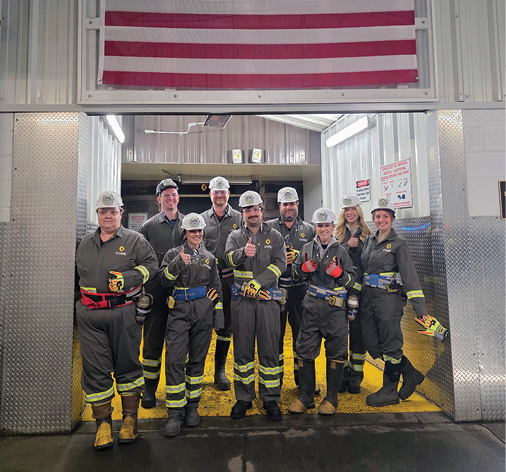
Editor’s note: NAM was part of the inaugural Core Natural Resources Down to the Core (DTTC) program, which invites professionals from across the mining industry and social media influencer spaces to visit an actively producing Core operation. We wish to thank Core and its corporate and mine staff for the opportunity and for selecting NAM to be part of its first DTTC class.
Core Innovations
Core Natural Resources’ Core Innovations business arm was created to expand coal’s value chain by developing and marketing products and technology with coal at its heart.
“Coal and coal-derived components are becoming crucial building blocks in the creation of exciting, new technologies that will reduce coal waste and create new jobs,” the miner said.
The current product line-up includes:
Battery materials: To help build renewable energy storage capacity, coal-derived carbon materials are being tested for use in making battery components. This work includes innovating alternatives for graphite, the primary component in lithium-ion battery anodes. Demand for graphite is projected to triple by 2030, and 98% of processed battery anode-grade graphite currently comes from China.
Building materials: Due to its abundance and affordability, as well as attractive properties like resistance to mold, mildew and fire, coal is being developed as an ingredient for building materials of the future, ranging from deck boards to roofing tiles to lightweight concrete to construction panels. These initiatives are aimed at providing more sustainable alternatives to conventional materials, like wood, steel and concrete, to meet the world’s staggering need for new infrastructure and construction, including two billion new homes expected to be built by the end of this century.
3D printing: Coal and waste coal are being researched for use in making 3D printable filament materials, which can in turn be used to create a myriad of carbon structures and shapes for applications like building and construction, tooling, and manufacturing parts. Again, its abundance, low cost, and sustainability profile make coal a material of great interest in this application.
Carbon fiber: Carbon fibers are extremely strong, extremely lightweight threads of carbon molecules that create a very durable, fabric-like material. With an atomic structure similar to graphite, carbon fibers bring so much strength for their weight that they’re used in countless products from sporting goods to bicycles to airplane wings. New technologies are being developed to enable coal and coal waste to be used as the primary feedstock for producing this high-performance material.